24.3.14

Artists & Entries


Artists
• Akerman, Mariano
• Bacon, Francis
• Bak, Samuel
• Beksiński, Zdzisław
• Bérain, Jean
• Boilly, Louis-Léopold
• Bolten, Arent van
• Bruegel the Elder, Pieter
• Callot, Jacques
• Chapman Brothers, Jake & Dinos
• Clovio, Giulio
• Coquelin, Antoine
• Desprez, François
• DeVille, Julia
• Delvoye, Wim
• Doré, Gustave
• Dubuffet, Jean
• Ernst, Max
• Fischli und Weiss
• Floris, Cornelis
• Fontanarrosa
• Fuller, Timothy Jacob
• Genovese, Alfredo
• Gervasi, Elvio
• González, Jesús
• Goya y Lucientes, Francisco
• Gravina, Francesco Ferdinando Il
• Hoefnagel, Joris
• Inga, Javier
• Kertész, André
• Kuksi, Kris
• Lequeu, Jean-Jacques
• Mäetam, Marko
• Maschen, Santos
• Marin, Livia
• Menasché, Sergio
• Messerschmidt, Franz Xaver
• Nine, Carlos
• Nowak, Till
• Oliehoek, Jan
• Ovchinnikov, Alexander
• Petitot, Ennemond-Alexandre
• Picasso, Pablo
• Piranesi, Giovanni Battista
• Quino
• Raphael
• Reinhardt, Ad
• Riccardi, Fabrizio [+]
• Salviati, Francesco
• Santos, Carlos
• Slarner, Liliana
• Tanguy, Yves
• Verona, Cachi
• Weber, Andreas Paul
• Wolverton, Basil
• Yamaguchi, Yuka


Entries
• A Curate's Egg
• A la búsqueda del factor grotesco
• A Procession of Grotesques
• Acerca de lo Grotesco en las pinturas de Bacon
• Alcances del sentimentalismo artístico
• Ars Poetica
• Arte argentino
• Arte grotesco: algunos de sus alcances
• As Funny as It Gets
• Art as Intention in Context
• Art Matters: Ideas & Themes Illustrated
• ¿Arte o Gato por Liebre?
• Artistic Imagination
• Artistic Monsters
• Aspectos grotescos del arte de Bacon
• Asunto de 6.000.000
• Atypical Beings
• Auricular Style
• Bacon: Painter with a Double-Edged Sword
• Bakhtin: The Body Grotesque
• Banham y la estética del colectivo porteño
• Best Regards to Medusa?
• Bien complejo y bien porteño
• Books: The Grotesque and Its Relatives
• Bretagne fantastique
• Buraq
• Capricious
• Chair-Ladder
• Clavileño el Alígero
• Configuraciones grutescas
• De la mímesis como problema
• De monstruos, prodigios y maravillas
• Decoração insólita
• Domus Aurea, Rome
• Double-Edged
• Educar con el ejemplo
• El factor grotesco
• El firulete, un asunto de importancia medular
• El juego de Bacon
• El laberinto del fauno
• El ser y el trabajo
• El todo mezclado
• Estética do grotesco: Christoff
• Estilo auricular
• European Ornamental Prints
• Figura en el espejo, 1971
• Flora Picturesque
• Francis Bacon en Buenos Aires
• Francis Bacon y lo Grotesco
• Fribolitus fribolitantis
• Gigantomachy
• Giornale Nuovo
• Grotesco el cuerpo
• Grotteschi
• Grotesques selon l'Encyclopédie Larousse
• Grotto-litera-turistika
• Hibridaciones varias
• Hindu Deities
• Historia de la Arquitectura
• Imaginary Art
• Insuperable en la sátira: Antonio Gasalla
• Jugando con fuego
• Kafka
• Kayser plus Bakhtin
• Kuntillet Ajrud
• La grottesca
• La Revelación según Bak
• La tradition des grotesques
• Las fuentes hispánicas del arte baconiano
• Las inscripciones de los carros
• L'écriture des grotesques
• Les Luthiers
• Les songes drolatiques de Pantagruel
• ¿Lo bello que en lo feo o lo feo que en lo feo?
• Lo familiar vuelto inquietante
• Lo Grotesco en las pinturas de Bacon
• Lo Grotesco en las pinturas instintivas de Bacon
• Lo imaginario
• Maniérisme : rébellion mélancolique
• Masquerade: Somewhere between the Mask and the Face
• Media and the Grotesque
• Medieval Grotesqueries
• Medieval Imagination
• Mi linda maestra
• Montaigne: Boscage or Crotesco
• "Multiplica las sonrisas"
• Netherlandish Realities
• ¿No es acaso el árbol un hombre?
• "No Grotesques in Nature"
• O fator grotesco
• O grotesco
• O grotesco nas artes visuais
• O império do grotesco
• Of Purpose in 20th-Century Art
• Ornament and the Grotesque
• Ortega y Gasset sobre la Metáfora
• Painters and Poets Alike
• Paradoxical Times
• Popular Science: Grotescology
• Quiebre y Derrame
• Resources
• Resourceful Jahsonic
• Rocaille
• Sacred Hybrid
• Shell and Content
• Significado de "A la que te criaste"
• Sólo nos es segura la inseguridad
• Terminología de las artes plásticas
• The Child Catcher
• The Creole Arabesque - El firulete criollo
• The Fear Factor
• The Fictitious Image
• The Grotesque
• The Grotesque in Bacon's Paintings
• The Grotesque in Bacon's Paintings, 1999-2009
• The Grotesque in Twentieth Century Art
• The Hour of Jeanne d'Évreux
• The Human Body in Modern Art
• The Macclesfield Psalter
• The Paradoxical
• The Uncanny
• Theatrical Murder
• Transgressing the Boundaries
• True Monsters
• T.S. Eliott, "The Hippopotamus," 1925
• T.S. Eliott, "The Hollow Men," 1925
• Um estilo marginal
• Versatilidad
• Viva la mezcla
• Viva la muerte


Bookmarks & Resources
• Bibliography
• Favorite Resources
• Grottesca
• Grotesco Online
• Links
• The Grotesque Times

21.3.14

Cornelis Floris

1508-1575

A Mannerist Netherlandish artist, Floris developed a bizarre set of designs featuring mascarons grotesques in 1555.[1]

Cornelis Floris, Grotesque Ornamental Mask (Mascaron), Antwerp, 1555
Etching by Frans Huys
Wolfsburg Kunstmuseum

In 1555, Floris designed between 18 and 22 sheets with human faces made up from vegetal elements, some highly stylized, others still recognizable as leaves and fruits. The images merge the animal and vegetable realms, and also the living and nonliving. Floris' designs intermix classical and not-so-classical components in most unexpected and extravagant ways.

Floris, Mascaron "i", Antwerp, 1555
Engraving by Huys
From: Pourtraicture ingenieuse de plusieurs façon de Masques. Fort utile aulx painctres, orseures, Taillieurs de pierres, voirriers et Taillieurs d'images (Ingenious portrayal of several types of masks. Useful for painters, stoneworkers [and other trades]).

Floris, Mascaron "h", 1555
Engraving by Huys (Pourtraicture ingenieuse).

Floris was born in Antwerp but spent some time in Rome in the late 1530s when he would have been exposed to examples of Ancient Roman and Renaissance grotesque decoration. The grotesque style often featured fanciful creatures--part human, part plant. The prints of Cornelis Floris have been described as having a sinister quality about them. In several of his prints, the combination of the auricular (ear-like) quality of the framework and the presence of individual figures apparently held prisoner by it, does give an unsettling effect (V&A).

Cornelis Floris
Ornamental Grotesque, Print "F", from Veelderleij Veranderinghe van grotissen ende Compertimenten ghemaeckt tot dienste van alle die de Conste beminne ende ghebruiken, Antwerp, 1556.[2]
Etching, 30.7 x 20.9 cm.
Published by Hieronymus Cock
Victoria & Albert Museum, London

The etching series Veelderleij Veranderinghe van grotissen ende Compertimenten are known in English as "Many Variations of Grottoes and Compartments."

Associated terms: putti, festoons, strapwork, shell motif, fantasy, snail, Auricular Style, imprisonment, Mannerist art.

Floris was a pioneer of the Auricular Style, which was to reach its a peak only in the 17th century.[3]

Johannes Lutma, Cartouche auriculaire, Amsterdam, 1633-54.
BnF, Paris.[4]

References
1. Incomplete sets of the suite are available from Amsterdam Rijksmuseum and MAK Vienna (Ornamental Prints Online). See also Carsten-Peter Warncke, Die ornamentale Groteske in Deutschland, 1500-1650, 2 vols., Berlin: Verlag Volker Spiess, 1979.
2. Désiré Guilmard, Les maitres ornemanistes : dessinateurs, peintres, architectes, sculpteurs et graveurs, Paris: E. Plon, 1880-81, p. 477 no. 6; Berlin Staatliche Museen, Katalog der Ornamentstichsammlung, Berlin and Leipzig, 1936-39, no. 211.1; Peter Ward Jackson, "Some Main Streams and Tributaries in European Ornament from 1500 to 1750", VAM, London, Victoria and Albert Museum, 1969, 38.
3. Auricular describes the smooth, curved, rippling and pliable shapes that resemble a human ear. Floris' prints are very early examples of this type of ornament which was developed by goldsmiths attempting to demonstrate organic forms extruding from the surface. The style probably influenced the later Baroque and Rococo movements: in various of his designs, Floris incorporates abstracted zoological motifs, in most cases relating to the ocean.
4. Guilmard, Maîtres ornemanistes, vol. 2, pl. 16.

Online Resources
• Misteraitch, Giornale Nuovo: Faces of the Grotesque, 2006
• Peacay, BibliOdyssey: Grotesque Mask Heads, 2011
• Akermariano, Imaginarium: Masquerade, Somewhere between the Mask and the Face, 2011

19.3.14

Raphael: The Vatican Loggia


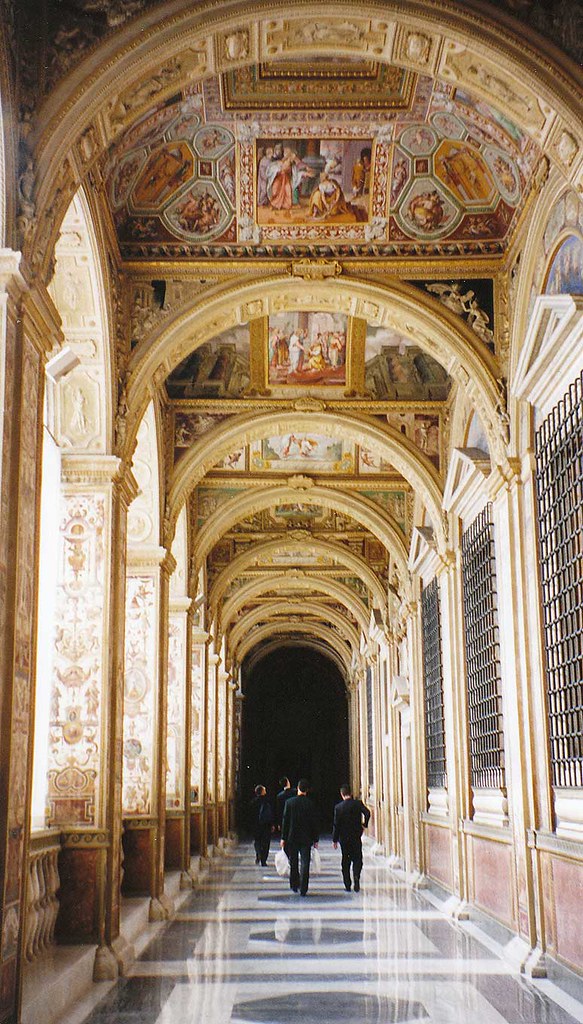
The loggia, or colonnaded porch, on the second story of the Apostolic Palace is one of the Vatican’s most remarkable art treasures; its decoration, designed by Raphael (1483—1520) and executed by his workshop in 1517- 1519, epitomizes the spirit of the Italian Renaissance in its synthesis of Christian and classical themes. The thirteen square vaults of Raphael’s loggia each contain four frescoes of scenes from the Bible, from the Creation to the Last Supper. Meanwhile, the plasterwork of the other architectural elements is decorated with "grotesques"—fanciful arabesques enlivened with a wide variety of human and animal figures—modeled after ancient Roman wall paintings. [...] the grotesque ornamental style elaborated by Raphael has been imitated as far afield as the corridors of the United States Capitol, and the Bible scenes served as influential models for popular prints.[1]

Raphael Sanzio and Giovanni da Udine
Detail from Pilaster IX, with acanthus foliage populated by animals, and flanking half-pilasters, with grotesque imagery.
fresco, 1515-19
Vatican Loggia, Apostolic Palace, Rome.[2]

The Raphael Loggia consists of numerous vaults, arches and pilasters forming a gallery sixty-five meters long and four meters wide. Its construction was begun by architect and painter Donato Bramante in 1512, under Pope Julius II and was completed by Raphael under the reign of Leo X. Raphael began work on the frescoes in 1517.

Raphael Sanzio and Giovanni da Udine
Pilaster with Grotesques, fresco, 1515-19
Loggie, Apostolic Palace, Rome
Colored engraving by Volpato & Ottaviani, 1772-77

Grotesque Motifs

Raphael and Da Udine
Grotesques, 1515-19
Detail from engraving by Volpato & Ottaviani (after drawings by Camporesi & Savorelli Teseo); Le Loggie di Rafaele nel Vaticano, Rome, 1772-77.

Half-Figure
From a set of gouache colored engravings
Le Loggie di Rafaele nel Vaticano, 3 vols., Rome, 1772-77.[3]

Raphael and Giovanni da Udine, Grotteschi (Grotesques, candelabrum arrangement), fresco, 1515-19. Pilaster detail. Papal Loggias, Vatican.[4]

Fantasy Style
Motivos Grutescos

Raphael and Giovanni da Udine, Grotteschi (Grotesques, candelabrum arrangement), fresco, 1515. Pilaster detail. Papal Loggias, Vatican

Rafael, Grotesque motif, 1515-19
Detail from engraving by Volpato & Ottaviani (after drawings by Camporesi & Savorelli Teseo); Le Loggie di Rafaele nel Vaticano, Rome, 1772-77.

Notes
1. Nicole Dacos, The Loggia of Raphael: A Vatican Art Treasure, Abbeville, 2008.
2. Ibid., p. 43, pl. 19.
3. Photograph by Alan Carroll, 2012 (Surface Fragments and photo-album). Engraving is by Volpato & Ottaviani (after drawings by Camporesi & Savorelli Teseo).
4. Photograph by Alessandro Vasari, c. 1880-90 (Istituto Nazionale della Grafica).

Photographic records from the original work

Loggia_Vaticana


Drawings, watercolors, and prints


Giovanni Volpato et Jean Renard
Les logges de Raphaël au Vatican


Ermitage


Giovanni Volpato Pilaster IV
Le Loggie di Rafaele nel Vaticano

Giovanni Volpato
Le Loggie di Rafaele nel Vaticano

Ermitage

Ermitage

Pierre Adrien Paris
Arabesques des loges de Raphaël au Vatican, 1773
Planche XCV
Besançon, Bibliothèque municipale, Vol. 482, n° 133


Pierre Adrien Paris
Arabesques des loges de Raphaël au Vatican, 1773
Planche XCVI
Besançon, Bibliothèque municipale, Vol. 482, n° 134

Détails d'arabesques (ou grotesques) des pilastres du décor des Loges de Raphaël au Vatican, 1775. Chaque planche est finement dessinée à l'encre et aquarellée, rassemblant différents motifs des pilastres internes des Loges, peints par Giovanni da Udine. Une feuille d'études d'ornements de la Renaissance qui date du pensionnat de Pâris à l'Académie de France à Rome et l'un des plus beaux dessins aquarellés du fonds de Besançon. Elle a fait partie des 81 planches d'études envoyées fin 1773 ou début 1774, et probablement des dessins que l'architecte a été exceptionnellement invité à présenter devant l'Académie royale d'architecture à Paris au printemps 1775.


Le Loggie di Rafaelo nel Vaticano
1775-77
Plates designed by P. Camporesi, G. & L. Savorelli Teseo
Engraved by G. Volpato & G. Ottaviani
Pilasters

Decorazione alla Grottesca

Tutti Frutti

Pilaster XVIII
Robert MacPherson (1811-1872).

Giovanni da Udine: Grottesche

Resources
Domus Aurea
Estilo fantasía de la antigua Roma
Sogni dei pittori

Musei Vaticanii
Related Posts Plugin for WordPress, Blogger...