23.8.12

Auricular Style

German Knorpelwerk or Ohrmuschelstil, Dutch kwabornament. A 17th-century ornamental style based on the human ear and other gristly parts.

Kwabornament
Mosyn of Amsterdam, Designs in Auricular Style, 1620

The auricular style was invented in the early 17th century by Dutch silversmiths and brothers Paulus and Adam van Vianen. Paulus was inspired by anatomy lectures he attended in Prague, and both he and Adam became known for the style, which was made popular by Johannes Lutma.

Christiaen van Vianen, Silver Dish in Auricular Style, 1635
Victoria & Albert Museum, London

Auricular ornament refers to a lobe-like decoration, like a thick dripping substance apparently resembling organic shapes. The word auricular refers to the ear, in particular to the earlobes. In the 17th century auricular ornamentation was known as "fratsen en snaeckerijen" (whimsy and drollery). Auricular ornament originated in the late-16th century as a two-dimensional form in ornamental prints. During the following century it was employed as a three-dimensional decorative element in window frames and picture frames. The silversmith Paulus van Vianen (1570-1613) used it so frequently that it became his trademark. When Paulus died, his brother Adam was commissioned to make a commemorative piece. He made a ewer as one continuous auricular design, thereby raising auricular ornament to a form in its own right (Shafe).

Adam van Vianen, Jar in auricular style, 1614
Rijksmuseum, Amsterdam

Auricular describes a type of ornament popular in the 17th century, characterized by smooth, curved and rippling forms resembling the human ear. This highly plastic style evolved during the first two decades of the 17th century in Utrecht, and in its fully developed form is found only in metalwork. The style in this medium is characterized by the use of amorphous, lobate scrolls and embossed, relief ornament that emphasize the malleable nature of the metal. At its most extreme, it exaggerates this quality by suggesting that objects were modelled in a semi-molten state. The goldsmiths Adam van Vianen and Paulus van Vianen of Utrecht are often credited with the invention of the style, although its origins seem to lie in the graphic designs of such 16th-century Italian Mannerist artists as Giulio Romano (e.g. drawing for a fish-shaped ewer; Oxford, Christ Church) and Enea Vico. The latter's designs for plate were published in the mid-16th century and may have been known in Utrecht (Oxford Grove Art).

Johannes Lutma
Cartouche auriculaire, Amsterdam, 1633-54
BnF Paris

The auricular style was adopted by cabinetmakers and carvers in both the Low Countries and Germany. In the Netherlands it was cultivated by Michel Mosyn of Amsterdam and Johannes Lutma; subsequently was developed in Germany by Friedrich Unteutsch and Johann Heinrich Keller.

Unteutsch, Knorpelwerk, 1650

Applied to chair backs, frames, cupboards, and other surfaces, the gruesome, curving motifs consisting of bones, membranes, and cartilage were arranged in baroque arabesques, suggesting the ear-like lobular qualities after which the style is named.

Keller, Knorpelgrotesk, 1680

The flabby, fleshy forms were sometimes contorted into masks, as shown in the Neues Zieratenbuch (New Ornamentation Book) of the designer Friedrich Unteutsch of Frankfurt am Main.

Knorpelwerk
Decorative frame in cartilaginous style
Germany, 17th century


Extravagant Monstrosities
Gold- and Silversmith Designs in the Auricular Style
by Femke Speelberg

One of the most curious styles to become fashionable in early seventeenth-century gold- and silversmith work is the so-called Auricular Style. The name derives from the style's characteristic idiom of organic fluid lines, shapes, and smooth surfaces, often reminiscent of cartilage and, in particular, the curvature of the ear. At first glance, the basic structure of artworks executed in the Auricular Style gives the impression of an object that has come out of its mold unsuccessfully. When studied more closely, however, the various forms and creatures that emerge from the solidified, organic mass—masks, (parts of) human figures and animals, including ray fish, slugs, and dragons—form convincing evidence of exactly the opposite. In fact, in most cases, the objects were not made by casting at all. They were fashioned, instead, from a smooth (silver) plate that was meticulously worked into intricate compositions using a hammer and chisels.

Many of the sometimes eerie qualities of the Auricular Style had already emerged in the arts of the previous century. References to the monstrous world of invertebrates and reptiles were a recurrent phenomenon in the ceramic creations of the workshop of Bernard Palissy (1510–1590); the Flemish grotesque designs of Cornelis Floris II (before 1514–1575) and Cornelis Bos (ca. 1510?–before 1566); and the artificial grottoes that adorned the gardens and houses of rich Italian families. The flowing, organic base structure of the designs is reflected in vessels made from natural stones (17.190.536) and other luxury objects fashioned from exotic objects such as shells and pearls.

The Auricular Style that emerged in the early seventeenth century went through its own distinct development, however, and—although used for various types of objects, including picture frames and gilt leather wallpaper—was connected in particular to the Dutch silver- and goldsmith trade. The great popularity of the style is usually explained by the Renaissance curiosity for the natural world, and the emergence of scientific research. The organic shapes, in particular, suggest that anatomical study and dissection played a significant part in the development of the characteristic idiom of the Auricular Style. Similar to anatomical abnormalities and exotic animals and objects, the appeal of these pieces therefore also lay in their role as objects of wonder, made for the elite to marvel at like many other treasures found in a so-called Kunst- und Wunderkammer.

Artists. Paulus Willemsz van Vianen (c. 1570–c. 1613/14), Adam van Vianen (c. 1568/69–1627), Gerbrand van den Eeckhout (1621–1674), and Johannes Lutma the Elder (1584–1669).

Blossoming in Print. Although a relatively large number of silver objects in the Auricular Style survive, a great many more designs are known because they were spread through prints, initially produced by descendants of the great masters. One of the earliest print series with Dutch Auricular designs was published by Christiaen van Vianen (c. 1598–1671). Under the alluring title Artful Models of Various Silver Vases and Other Capricious Works, he presented the ingenuity and breadth of his father's designs to the world. Jacob Lutma (c. 1624–1654), son of Johannes Lutma the Elder, soon followed suit with a series celebrating the works of his father. The great appeal of these works inspired print publishers to compile other series of Auricular designs. Cornelis Danckertsz I (c. 1603–1656), for example, combined designs by all the great protagonists of the style in one series entitled Various Artful Inventions to be Applied in Gold, Silver, Wood, and Stone. Although the print run for most of these series seems to have been limited, the multilingual title pages suggest that they were meant to be distributed throughout the European continent. Christiaen van Vianen chose to print his titles in Italian, French, and Dutch, all of which he economically placed on the same page. In contrast, the Amsterdam publisher Clement de Jonghe decided it was worth his while to produce three individual title pages for the series of Auricular cartouches by Gerbrand van den Eeckhout. Most other existing copies of the series suggest that only one of the title pages, in Dutch, French, or Latin, would be chosen to accompany the designs, depending on the intended customer(s).

The publication of Auricular designs did not occur when the style first emerged in the early seventeenth century, but rather in the late 1640s and 1650s, toward, or in some cases even well after, the end of the artists' careers. This is generally thought to have something to do with the protection of artistic and intellectual property. At the same time, however, it also proved very beneficial to the descendants and followers of Paulus and Adam van Vianen and Johannes Lutma the Elder, as the publication of the designs in prints spurred a renewed interest and demand for designs in this style which they gladly provided (MET-NY).


Resources
• Akerman, Luis Mariano. Francis Bacon y lo Grotesco, lecture, Buenos Aires, Universidad de Belgrano, August 2009
Auricular Ornament, Rijksmuseum, Holland, accessed 25.9.2012
Auricular Style, Encyclopaedia Britannica, United Kingdom, accessed 20.12.2010
Auricular Style, Oxford Grove Art, United Kigdom, accessed 25.9.2012
Grotesques, Dictionnaire de la peinture Larousse, France, accessed 3.11.2010
• Guilmard, Désiré. Les maîtres ornemanistes, Paris, 1880-1
• Shafe, Laurence. Early Stuart: Tapestry and Goldsmith Work, History of Art, 2006
• Singleton, Esther. The Dutch and Flemish Furniture, The McClure Company, 1907, The Duch Home, Part 9 
• Speelberg, Femke. Extravagant Monstrosities: Gold- and Silversmith Designs in the Auricular Style, Heilbrunn Timeline of Art History, New York: The Metropolitan Museum of Art, 2000–14
Wikimedia Commons


Mariano Akerman, Sheba, sanguine, 1995

Additional Material
Auricular Style
Rijksstudio Akermariano
Kwabornament, V&A, Rijksmuseum, Museumnetwork, Old Book Illustrations, BibliOdyssey, Framing Charles II, Victorian jug, DeVille.
The Auricular Style: Frames Conference, Wallace Collection, 5-6 October 2016
The Grotesque Times

13.5.12

Villa Palagonia

by Jahsonic

The Villa Palagonia is a patrician villa in Bagheria, 15 km from Palermo, in Sicily, southern Italy. The villa itself, built from 1715 by the architect Tommaso Napoli with the help of Agatino Daidone, is one of the earliest examples of Sicilian Baroque. However, its popularity comes mainly from the statues of monsters with human faces that decorate its garden and its wall, and earned it the nickname of "The Villa of Monsters" (Villa dei Mostri). This series of grotesques, created from 1749 by Francesco Ferdinando II Gravina, Prince of Palagonia, aroused the curiosity of the travellers of the Grand Tour during the 18th and 19th centuries, for instance Henry Swinburne, Patrick Brydone, John Soane, Goethe, the Count de Borde, the artist Jean-Pierre Houël or Alexandre Dumas, prior to fascinate surrealists like André Breton or contemporary authors such as Giovanni Macchia and Dominique Fernandez, or the painter Renato Guttuso.

Francesco Ferdinando II Gravina, Grotteschi (Grotesques), Villa Palagonia, 1749
Bagheria, Sicily

Whenever I like something which is considered to be in poor taste, I review it by digging up some negative review by a detractor. Today’s object of my affection is the Villa Palagonia in Sicily.

But the Villa Palagonia once surpassed in absurdity anything ever conceived by mortal brains. It was the mad fancy of a Prince of this name who lived in the last century to people his house and grounds with monsters more outrageous and ridiculous than the creations of Circe, Armida, or the enchanters of romance. Of all that immense group there is not one made to represent any object in nature, nor is the absurdity of the wretched imagination that created them less astonishing than its wonderful fertility. It would take a volume to describe the whole, and a sad volume indeed it would make. He has put the heads of men to the bodies of every sort of animal, and the heads of every other animal to the bodies of men. Sometimes he makes a compound of 5 or 6 animals that have no sort of resemblance in nature. He puts the head of a lion to the neck of a goose, the body of a lizard, the legs of a goat, the tail of a fox. On the back of this monster he puts another, if possible still more hideous, with 5 or 6 heads and a bush of horns that beats the beast in the Revelations [Book of Revelations or John's Apocalypse] all to nothing. There is no kind of horn in the world that he has not collected, and his pleasure is to see them all flourishing upon the same head. —Patrick Brydone.

The interior of the palace was as fantastical as the outside, and its manifold extravagances were multiplied a thousand times by mirrors placed at different angles. Most of these absurdities have been removed, but a few still remain in the garden to attest the extravagant folly of the old prince; while at one entrance to the palace statues of his ancestors stand like lacqueys in suits of many-coloured marbles, and round the bell-room busts of the same stand out from the walls in bodily relief, dressed to the life in marble. —A handbook for travellers in Sicily: including Palermo, Messina (1864), George Dennis, John Murray
The previous text cites Patrick Brydone on the villa Palagonia. Two other texts deserve to be mentioned here. The first Les monstres de Bomarzo (1957) by French writer André Pieyre de Mandiargues connects Villa Palagonia with that other icon (and much better-known) of the grotesque:

Une autre histoire que l’on raconte à Bomarzo est celle d’une jeune et noble dame, belle en outre, à laquelle un mari … la même exactement que l’on raconte à la villa Palagonia et dans tous les lieux ornés de monstres de pierre.

The second text to connect Boomarzo to Palagonia was Bellezza e bizzarria (1960) by Mario Praz:

Ma di vere e proprie bizzarrie nell’aria aperta dei giardini l’Italia può vantarne solo due, ma supreme: i mostri di Bomarzo ei grotteschi di Villa Palagonia vicino a Palermo. In Inghilterra le bizzarrie, senza essere cosi monumentali.

9.5.12

Yves Tanguy


Raymond Georges Yves Tanguy was born on January 5, 1900, in Paris. While attending lycée during the 1910s, he met Pierre Matisse, his future dealer and lifelong friend. In 1918 he joined the Merchant Marine and traveled to Africa, South America, and England. During military service at Lunéville in 1920, Tanguy became a friend of the poet Jacques Prévert. He returned to Paris in 1922 after volunteer service in Tunis and began sketching café scenes that were praised by Maurice de Vlaminck. After Tanguy saw Giorgio de Chirico’s work in 1923, he decided to become a painter. In 1924, he, Prévert, and Marcel Duhamel moved into a house that was to become a gathering place for the Surrealists. Tanguy became interested in Surrealism in 1924, when he saw the periodical La Révolution surréaliste. André Breton welcomed him into the Surrealist group the following year.
Despite his lack of formal training, Tanguy’s art developed quickly and his mature style emerged by 1927. His first solo show was held in 1927 at the Galerie Surréaliste in Paris. In 1928 he participated with Jean Arp, Max Ernst, André Masson, Joan Miró, Pablo Picasso, and others in the Surrealist exhibition at the Galerie au Sacre du Printemps, Paris. Tanguy incorporated into his work the images of geological formations he had observed during a trip to Africa in 1930. He exhibited extensively during the 1930s in solo and Surrealist group shows in New York, Brussels, Paris, and London.
In 1939 Tanguy met the painter Kay Sage in Paris and later that year traveled with her to the American Southwest. They married in 1940 and settled in Woodbury, Connecticut. In 1942 Tanguy participated in the Artists in Exile show at the Pierre Matisse Gallery in New York, where he exhibited frequently until 1950. In 1947 his work was included in the exhibition Le Surréalisme en 1947, organized by Breton and Marcel Duchamp at the Galerie Maeght in Paris. He became a United States citizen in 1948. In 1953 he visited Rome, Milan, and Paris on the occasion of his solo shows in those cities. The following year he shared an exhibition with Kay Sage at the Wadsworth Atheneum in Hartford and appeared in Hans Richter’s film 8 x 8. A retrospective of Tanguy’s work was held at the Museum of Modern Art in New York eight months after his death on January 15, 1955, in Woodbury.

Tanguy, Le soleil dans son écrin (The Sun in Its Jewel Case), 1937
Oil on canvas, 115.4 x 88.1 cm
The Guggenheim Collection, Venice

Tanguy arrived at his lunar or submarine morphology in about 1927, and spent the rest of his artistic career exploring and elaborating it without changing its essential character. His compositions, arrived at in an unpremeditated manner directly on the canvas, recall the landscape of Locronan, in the French province of Brittany, where he spent childhood summers at a house owned by his parents. The repertory of memory was augmented by his experience of Africa during a trip of the early 1930s. After this the light in his paintings became clear and strong and the color schemes more complex. Vegetal forms were replaced by mineral formations. Dolmens and menhirs, stone remnants of prehistoric ages, and fossilized bones were smoothed and tinted in the dream spaces of his canvases. The assertive shadows cast in these landscapes recall those of Giorgio de Chirico, whose example had inspired Tanguy to take up painting in 1923.
The spatial paradox of The Sun in Its Jewel Case depends on the merging of sky and earth, achieved through the continuous gradation of color over the surface—there is no horizon line—and the device of a diagonal line of forms shown receding in perspective from lower right to upper left. Acute angles are suggested throughout, by the placement of objects, by the relationship of shadows to objects, or by the things themselves. Geometric precision and a minutely detailed academic technique, in which careful modeling lends plastic solidity to form, heighten the poetic strangeness of Tanguy’s world.

Lucy Flint
Guggenheim Collection Online

21.3.12

Ars Poetica


Just don't expect it to roar, 2006

Horace, Ars Poetica, 20 BCE. "Painters and poets alike have always had an equal prerogative to dare anything," you say?—We know. This is a concession: we both ask for and grant the same license. But not so far as to unite the mild with the savage, or to couple snakes with birds, and lambs with tigers.


Roman mosaic from Carthage, Tunisia
Bardo Museum, Tunis

French Medieval Gargoyle

French gothic sculpture
A hybrid being, misericord from Rodez Cathedral

Hybrid being, detail from the Map of Hereford, 1310
Baltrusaitis: Réveils et Prodiges

Zebo da Firenze, Grotesque flutist, France, 1408
Oxford, Bodleian Library, MS Douce 144, fol. 28v

Rafael Sanzio, Grotesque motif, 1515

Marco Dente, after Raphael
Grotesque, ornamental engraving, early 16th century

François Desprez, Les songes drolatiques de Pantagruel, 1565

Giuseppe Arcimboldo, Vertumnus, oil (detail), 1590
Skokloster Castle, Sweden

A grotesque motif from a mannerist engraving

Christoph Jamnitzer, Neuw Grotteßken Buch, Nuremberg 1610

Jean-Jacques Lequeu, Grotesques, sketches, 1786
BNF, Paris

James Gillray, Excrecence, engraving, 1791

Composition with Hybrid Beings, England, 1865
Painted porcelain panel, after a design by Lucas van Leyden
Victoria & Albert Museum, London

Then Lilies turned to Tigers
Arts & Crafts Movement, England, 19th Century

Philippe Wolfers, Dragonfly, jewelry, c.1900

Max Ernst, She looked slightly like a horse, collage, 1937

René Magritte, La saveur des larmes, 1948
Musées royaux des beaux-arts de Belgique, Bruxelles

Francis Bacon, Fragment of a Crucifixion, 1950
Oil and cotton on canvas, 139 x 108 cm
Stedelijk van Abbenmuseum, Eindhoven

Roberto Fontanarrosa, "If there's something we should discard... that's sterility," c.1982

Mariano Akerman, Three Figures by the Window, 1989

Patricia Piccinini, The Young Family, 2002

Santos Maschen, Dragon, Filete Porteño, 2005

A Flying Pig, c.2006

Carlos Nine, Hommage à l’arrière-cour, 2008

Thomas Mangold
„Aus einer Mücke eine Elefanten machen”
To make an elephant out of a mosquito, 2010
photograph and computer graphic design
Artist's remark: "If you rearrange reality and/or approach it in a new and unfamiliar angle there are endless possibilities to create stunning stuff."

Grotesque motif

Mariano Akerman
Plate relating visual motifs to Horace's lines in Ars Poetica, 2008

19.2.12

The Fear Factor


Once Upon a Time... Charles Perrault, Histoires ou contes du temps passé, 1697: The Wolf, from Little Red Riding Hood

The Fear Factor in Post-Biblical Imagery
Images of Otherness, Prejudices, and Stereotypes

a. Law of segregation: canon or apocrypha?
b. Fruits of Divorce: Prejudices
c. Stereotype: the shortest way, but to where?
d. Author and Aim
e. Social Psychology and the big Why: Individual and Society


Disconnection Time

Stereotype. A stereotype is a popular belief about specific types of individuals. Stereotypes are standardized and simplified, rigid conceptions of groups based on some prior assumptions. The term stereotype derives from the Greek words στερεός (stereos), "firm, solid," and τύπος (typos), "impression," hence "solid impression"; in 1850 English it means "image perpetuated without change" (Online Ethimology Dictionary).
Sociologist Charles E. Hurst explains that "one reason for stereotypes is the lack of personal, concrete familiarity that individuals have with persons in other racial or ethnic groups. Lack of familiarity encourages the lumping together of unknown individuals." Stereotypes focus upon and thereby exaggerate differences between groups. Competition between groups minimizes similarities and magnifies differences. Reliance on stereotypes appears to be heightened with increased exposure to stereotypes, regardless of whom the stereotype is portraying.

A theory as to why people stereotype is that it is too difficult to take in all of the complexities of other people as individuals. Even though stereotyping is inexact, it is an efficient way to mentally organize large blocks of information. Categorization is an essential human capability because it enables us to simplify, predict, and organize our world. Once one has sorted and organized everyone into tidy categories, there is a human tendency to avoid processing new or unexpected information about each individual. Assigning general group characteristics to members of that group saves time and satisfies the need to predict the social world in a general sense.

Possible prejudicial effects of stereotypes are:
1. Justification of ill-founded prejudices or ignorance
2. Unwillingness to rethink one's attitudes and behavior towards stereotyped group
3. Preventing some people of stereotyped groups from entering or succeeding in activities or fields


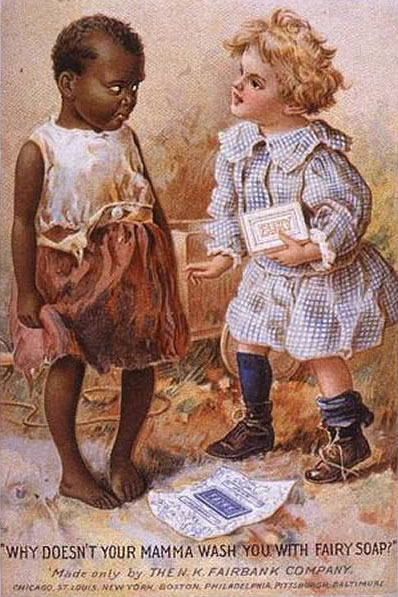
Is this ad objectionable? Yes? No? Why?

Stereotypes involve the exaggeration of certain features or characteristics of "the other," with the specific purpose of emphasizing the "otherness" so to convey the idea that the "other" is something else than human (less than human, ridiculous, pathetic, disgusting, monstrous, inhuman).


Stereotypes tend to dehumanize "the other" and legitimize patterns of prejudice, disrespect, segregation, discrimination, and violence.


Brook Andrew, Sexy and Dangerous, digital image, 1996

The Exotic Human: Other Cultures as Amusement. Klulsy Lamko reviews a 2009 exhibition at Teylers Museum, Haarlem (NL), and Museum Guislain, Ghent: "What with the creationists and the evolutionists, prejudice decidedly still has a lot of life left in it. An intriguing question, the origin of man! [...] The exhibition, which brings together posters, photographs, masks, colonial objects, sculptures, documentaries, books, etc. in a formal post-modern perspective, boldly returns to the theme of the perception of Otherness as promulgated for centuries in Europe. Tribes of Africans, Indians, Aboriginees, Greenlanders, Samoans and Pakistanis, huts, forests, temples, slavery, the 1897 Colonial Exhibition in Tervuren, scientific expeditions, craniometry, anthropometry, the Hottentot Venus, the colour chart, DNA – in a word, biology, culture and history – are cheerfully jumbled together, revealing the commonalities on which racism, slavery, colonisation and apartheid were founded. In a nutshell, Others, because they are different, are animals, or almost: they are in a state of nature, ugly, bizarre, comic, savage, violent, devoid of reason, cannibals – in a word, for all these reasons, exotic!


Robert Crumb, Angelfood McSpade: "She's All Heart." c. 1970

What is the purpose of such a daring exhibition on this sensitive subject? The answer is complex. To hold up a mirror, to confront us with our own history? The aim of educating and reminding us is undoubtedly laudable. Indeed, if it invites us to look twice, in other words to examine the unhealthy, hierarchical, destructive attitude to Others, if it leads us to question the stupidity of pseudo-scientific attempts at racial characterisation and hierarchal organisation, if it elicits from visitors not an amused smile (short of an unusual capacity for self-ridicule) but a grimace of disgust, we can feel reassured.
Conversely, if, instead of being perceived as a scathing denunciation, the exhibition confirms visitors in their stereotypes, it would be monstrous. There is nothing against being entertained, but because of the multiple meanings that images can have, a good deal of care is called for in the way objects are presented (in this case a unilateral point of view, lifeless legends, heterogeneity, etc.) – especially when conjuring up the muddy swamp where human thought has become bogged down in justifying atrocities. It is not so long since the colonial era when, by dint of imposing rules and measuring legs and noses, the social categories Tutsi and Hutu were transformed into rival ethnic groups, thus laying the foundation for the genocide of the Tutsis in Rwanda. James Watson’s racist arguments are still current. There is still a danger of being drawn into a progression: you become a scientific profile, a negroid type, an anthropological debate, a photographic subject."

"Four of five men want Oxfords in these new Van Heusen styles"
Discriminatory shirts ad, U.S., 1952 (Gawker)

"But what is a black? And, first of all, what color is his color?" —Jean Genet, playwright, 1910-1986

"Why doesn't your mamma wash you with Fairy Soap?"
Racist soap ad, U.S., undated (Oddee)
Racism in the United Sates

"Biological laws tell us that certain divergent people will not mix or blend. The Nordics propagate themselves successfully. With other races, the outcome shows deterioration on both sides." —Future US president Calvin Coolidge, "Whose Country is This?," Good Housekeeping, 1921, 14.


Alberto Giacometti, Walking Man, bronze, 1960

The Portrayal of Jews. Stereotypes are generalizations and Jewish people have been stereotyped for over two millennia throughout Europe and the Western hemisphere as scapegoats for a multitude of societal problems (Mortimer Ostow, Myth and Madness: the Psychodynamics of Antisemitism, Transaction Publishers, 1996, p. 61). Antisemitism continued throughout the centuries and reached a climax in the Third Reich during World War II.
Jews are stereotyped as greedy. In caricatures and cartoons, they are depicted having large hook-noses, thick lips, curly hair, large dark-colored eyes, olive brown skin, and wearing hats or kippahs.[1] They are shown as evil, deceitful outsiders, greedy and repulsive.[2]
The portrayal of Jews as historic enemies of Christianity constitutes the most negative stereotype and is reflected in the imagery of the late-10th through early-12th centuries, where they appear as menacing and satanic. Although Jews had not been particularly associated with moneylending in Antiquity, a stereotype of them acting in this capacity was developed beginning in the 11th century. As Jews were forbidden from owning land by the church, many went into money-lending and usury. This led to, through the Middle Ages and the Renaissance, the association of Jews with greedy practices. Jonathan Frankel notes that this stereotype, though obviously an exaggeration, had a solid basis in reality: while not all Jews were moneylenders, it does seem to have been true that Jews were disproportionately represented in the trade (The Fate of the European Jews, 1939-1945: Continuity or Contingency?, Oxford UP, 1997, p. 16). Publications such as William Shakespeare's The Merchant of Venice (1596-98), Charles Dickens's Oliver Twist (1838), and The Protocols of the Elders of Zion (1903) reinforced the stereotype of the crooked Jew.


In nineteenth-century English literature, the most common portrayal of a Jew was a negative racial stereotype. In society, and thus in literature, Jews were often seen in terms of their "otherness"—their difference in appearance, social standing, religion and values with respect to their non-Jewish counterparts. This is especially true of the fiction of the early nineteenth-century when the ghost of Shakespeare’s greedy, evil Shylock still haunted English literature. However, even when Jews gained political equality in England with the passage of numerous reforms and a rise in realism in fiction caused novelists writing in the mid-1800s to look increasingly to real life rather than to established stereotypes as inspiration for their writing, Jews were portrayed in exaggerated terms as completely evil or impossibly virtuous; as wealthy politicians and international financiers or lowly impoverished immigrants; as people seeking complete assimilation into English culture or as adamantly separatist.
Sir Walter Scott produced the first novel-length treatment of Jewish characters in Ivanhoe (1819), but Charles Dickens was to engender one of the most influential examples of the stereotypical "evil Jew"—the character of Fagin in Oliver Twist (1838). Significantly, "the image of the Jew in English literature has been a depressingly uniform and static phenomenon" (Edgar Rosenberg, 1960). That phenomenon is mostlyt due to Dickens.
Western stereotypes of Jews portray them in the negative terms of money-mad.[3][4] The stereotype "all Jews are rich" has been a staple for anti-Semitism for centuries. This stereotype is not used to tell people how hard Jews work, or how smart they are, but to portray them as thieves. In the U.S., public opinion polls taken from the mid-1930s to the late-1940s showed that over half the American population saw Jews as greedy and dishonest. Those polls also indicated that many Americans believed that Jews were too powerful in the United States. Although only 0.6 percent of the nation's 93,000 commercial bankers in 1939 were Jewish, the idea that Jews controlled the banking system remained a popular myth. Besides, stereotypes were not so much rooted in religion as they were in envy, jealously and fear of Jewish affluence (and of the hidden power of "Jewish money").


Shakespeare gives Shylock one of his most eloquent speeches: "Hath not a Jew eyes? Hath not a Jew hands, organs, dimensions, senses, affections, passions? ... If you prick us do we not bleed? If you tickle us, do we not laugh? If you poison us, do we not die? And if you wrong us, shall we not revenge?" (Act III, scene I)


Al Pacino on Shylock: “I was able to see those human elements of the character. I started to understand the motivation. [...] I didn’t know how I would approach it. But I saw a character that I could understand and identify with.” Pacino acknowledges that it’s not a simple play with a simple theme. When asked what he perceives to be the play’s message, he pauses, and then says “tolerance.” After a second, longer pause, he says, “It’s a difficult play to relate to. There are aspects that I relate to. And certainly Shylock’s condition, his dilemma, his plight, I relate to that. I can only speak from that character. I really can’t tell you too much about my feelings for the whole play. I have ambivalent feelings about different aspects of it” (Interview by Jeff Wilser, 2008; TCS).

Mariano Akerman, Prickly Matters (453 Grams of Living Matter), 2009
The Merchant of Venice has long provoked controversy, though one argues it can be interpreted as a plea for mutual respect.

"I am always asked whether or not Jews have a 'Semitic' nose. After 54 years of experience I can only answer that every Jew I have ever met has a nose!" —Sander L. Gilman, historian, 1944

The nineteenth-century "Aryan" Jesus and his recent "Semitic" counterpart look simplistic as soon as one compares them with Rembrandt's seventeenth-century Portrait of a Young Jew as Christ.

Stereotypes shape the picture that we have of ourselves and of "others." They are simplifications which supposedly help us to understand a complex world and to overcome our fear of the unknown. At the same time, they provide material for racist ideologies. One may well question how such ascriptions and characterizations arise.

A collection of stereotypes

Typical! is a 2008-11 exhibition about the stereotyped seeing, perceiving, and compartmentalizing of images and objects. Stereotypes and clichés are an integral part of our perception that shapes our image of ourselves and of "others" and our sense of belonging to a group or a nation separate from other groups and nations. It’s impossible to imagine pop culture without characterizations and classifications, which through their simplification may help us to overcome our fear of the unknown, but at the same time can also provide us with a breeding ground for racist ideologies (JMB).

"I'm astound by people who want to 'know' the universe when it's hard enough to find your way around Chinatown." —Woody Allen, American film director

Stereotyping in media. Not all stereotyping is bad. Stereotyping arises out of the need to generalize in order to make sense out of a very complicated environment. It allows people to easily categorize new things into comfortable spaces already defined by their experiences. This process was described in 1922 by Walter Lippmann, who first coined the term "stereotyping." Lipmann wrote, "the attempt to see all things freshly and in detail, rather than as types and generalities, is exhausting, and ... practically out of the question" (Public Opinion).
The media uses stereotypes as a shorthand method of defining characters in ways that are easy for people to identify and categorize. What these stereotypes all have in common is that they reduce to a one-sided, superficial and exaggerated depiction the real variety, depth and complexity of a people. Negative stereotyping arises out of an ethnocentric view of the world; ones own group is the center of everything and all other groups are rated in reference to it. Negative stereotypes are prejudicial judgments that assign negative qualities to other groups.
Because stereotypes often contain a "kernel of truth" (they may be characteristic of some or many members of a group) they are widely accepted as the truth. However, specific tendencies that may be widespread among a group should never be applied to every member of a group. That's because the stereotypes generalize individuals within a group, emphasizing sameness and ignoring individual variety.
Repetition tends to normalize stereotypes, because repeating stereotypes validates and perpetuates them. When members of one group think about members of another group as "bad" or worse, sub-human, they are likely to inflict harm upon them. Racist stereotypes can even justify actions that would normally be unimaginable, as was the case with Germany during WWII. Hitler's anti-Semitism could never have precipitated the Holocaust if Germans didn't already have a long history of anti-Semitic beliefs and actions. The repetition of negative racial stereotypes about Jews and other so-called "undesirables" ultimately propelled ordinary Germans to systematically kill millions of innocent human beings.
Negative racial stereotyping was used by all sides during WWII to demonize enemies. Racist stereotypes were also used to justify a steady stream of civilian deaths and crimes against humanity, and the US was no exception. The firebombing of Dresden and Tokyo as well as the atomic bombs that were dropped on Japan caused human slaughter on a massive scale. Ordinary Americans believed these actions were justified because of the negative stereotyping of America's enemies that preceded the war, and the more virulent forms that emerged during the war.
The media today is more sensitive to issues of culture and gender than it once was, but the creation and perpetuation of common misconceptions about groups of people continues. Oversimplified and inaccurate portrayals have profoundly affected how we perceive one another, how we relate to one another and how we value ourselves (racist-stereotypes.com).

Baron's stereotypes in extremis: Brüno, Bórat, and Ali G.

Resources
Estereotipo
Sociological Images
Invoking the Primitive
Sambo in racist cartoons
Sinophobia
Stereotypes in Disney's work
Lo familiar vuelto inquietante
Related Posts Plugin for WordPress, Blogger...