19.2.12

The Fear Factor


Once Upon a Time... Charles Perrault, Histoires ou contes du temps passé, 1697: The Wolf, from Little Red Riding Hood

The Fear Factor in Post-Biblical Imagery
Images of Otherness, Prejudices, and Stereotypes

a. Law of segregation: canon or apocrypha?
b. Fruits of Divorce: Prejudices
c. Stereotype: the shortest way, but to where?
d. Author and Aim
e. Social Psychology and the big Why: Individual and Society


Disconnection Time

Stereotype. A stereotype is a popular belief about specific types of individuals. Stereotypes are standardized and simplified, rigid conceptions of groups based on some prior assumptions. The term stereotype derives from the Greek words στερεός (stereos), "firm, solid," and τύπος (typos), "impression," hence "solid impression"; in 1850 English it means "image perpetuated without change" (Online Ethimology Dictionary).
Sociologist Charles E. Hurst explains that "one reason for stereotypes is the lack of personal, concrete familiarity that individuals have with persons in other racial or ethnic groups. Lack of familiarity encourages the lumping together of unknown individuals." Stereotypes focus upon and thereby exaggerate differences between groups. Competition between groups minimizes similarities and magnifies differences. Reliance on stereotypes appears to be heightened with increased exposure to stereotypes, regardless of whom the stereotype is portraying.

A theory as to why people stereotype is that it is too difficult to take in all of the complexities of other people as individuals. Even though stereotyping is inexact, it is an efficient way to mentally organize large blocks of information. Categorization is an essential human capability because it enables us to simplify, predict, and organize our world. Once one has sorted and organized everyone into tidy categories, there is a human tendency to avoid processing new or unexpected information about each individual. Assigning general group characteristics to members of that group saves time and satisfies the need to predict the social world in a general sense.

Possible prejudicial effects of stereotypes are:
1. Justification of ill-founded prejudices or ignorance
2. Unwillingness to rethink one's attitudes and behavior towards stereotyped group
3. Preventing some people of stereotyped groups from entering or succeeding in activities or fields


Is this ad objectionable? Yes? No? Why?

Stereotypes involve the exaggeration of certain features or characteristics of "the other," with the specific purpose of emphasizing the "otherness" so to convey the idea that the "other" is something else than human (less than human, ridiculous, pathetic, disgusting, monstrous, inhuman).


Stereotypes tend to dehumanize "the other" and legitimize patterns of prejudice, disrespect, segregation, discrimination, and violence.


Brook Andrew, Sexy and Dangerous, digital image, 1996

The Exotic Human: Other Cultures as Amusement. Klulsy Lamko reviews a 2009 exhibition at Teylers Museum, Haarlem (NL), and Museum Guislain, Ghent: "What with the creationists and the evolutionists, prejudice decidedly still has a lot of life left in it. An intriguing question, the origin of man! [...] The exhibition, which brings together posters, photographs, masks, colonial objects, sculptures, documentaries, books, etc. in a formal post-modern perspective, boldly returns to the theme of the perception of Otherness as promulgated for centuries in Europe. Tribes of Africans, Indians, Aboriginees, Greenlanders, Samoans and Pakistanis, huts, forests, temples, slavery, the 1897 Colonial Exhibition in Tervuren, scientific expeditions, craniometry, anthropometry, the Hottentot Venus, the colour chart, DNA – in a word, biology, culture and history – are cheerfully jumbled together, revealing the commonalities on which racism, slavery, colonisation and apartheid were founded. In a nutshell, Others, because they are different, are animals, or almost: they are in a state of nature, ugly, bizarre, comic, savage, violent, devoid of reason, cannibals – in a word, for all these reasons, exotic!


Robert Crumb, Angelfood McSpade: "She's All Heart." c. 1970

What is the purpose of such a daring exhibition on this sensitive subject? The answer is complex. To hold up a mirror, to confront us with our own history? The aim of educating and reminding us is undoubtedly laudable. Indeed, if it invites us to look twice, in other words to examine the unhealthy, hierarchical, destructive attitude to Others, if it leads us to question the stupidity of pseudo-scientific attempts at racial characterisation and hierarchal organisation, if it elicits from visitors not an amused smile (short of an unusual capacity for self-ridicule) but a grimace of disgust, we can feel reassured.
Conversely, if, instead of being perceived as a scathing denunciation, the exhibition confirms visitors in their stereotypes, it would be monstrous. There is nothing against being entertained, but because of the multiple meanings that images can have, a good deal of care is called for in the way objects are presented (in this case a unilateral point of view, lifeless legends, heterogeneity, etc.) – especially when conjuring up the muddy swamp where human thought has become bogged down in justifying atrocities. It is not so long since the colonial era when, by dint of imposing rules and measuring legs and noses, the social categories Tutsi and Hutu were transformed into rival ethnic groups, thus laying the foundation for the genocide of the Tutsis in Rwanda. James Watson’s racist arguments are still current. There is still a danger of being drawn into a progression: you become a scientific profile, a negroid type, an anthropological debate, a photographic subject."

"Four of five men want Oxfords in these new Van Heusen styles"
Discriminatory shirts ad, U.S., 1952 (Gawker)

"But what is a black? And, first of all, what color is his color?" —Jean Genet, playwright, 1910-1986
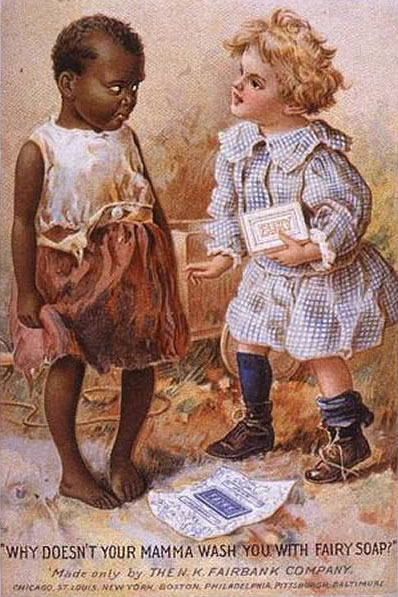
"Why doesn't your mamma wash you with Fairy Soap?"
Racist soap ad, U.S., undated (Oddee)
Racism in the United Sates

"Biological laws tell us that certain divergent people will not mix or blend. The Nordics propagate themselves successfully. With other races, the outcome shows deterioration on both sides." —Future US president Calvin Coolidge, "Whose Country is This?," Good Housekeeping, 1921, 14.


Alberto Giacometti, Walking Man, bronze, 1960

The Portrayal of Jews. Stereotypes are generalizations and Jewish people have been stereotyped for over two millennia throughout Europe and the Western hemisphere as scapegoats for a multitude of societal problems (Mortimer Ostow, Myth and Madness: the Psychodynamics of Antisemitism, Transaction Publishers, 1996, p. 61). Antisemitism continued throughout the centuries and reached a climax in the Third Reich during World War II.
Jews are stereotyped as greedy. In caricatures and cartoons, they are depicted having large hook-noses, thick lips, curly hair, large dark-colored eyes, olive brown skin, and wearing hats or kippahs.[1] They are shown as evil, deceitful outsiders, greedy and repulsive.[2]
The portrayal of Jews as historic enemies of Christianity constitutes the most negative stereotype and is reflected in the imagery of the late-10th through early-12th centuries, where they appear as menacing and satanic. Although Jews had not been particularly associated with moneylending in Antiquity, a stereotype of them acting in this capacity was developed beginning in the 11th century. As Jews were forbidden from owning land by the church, many went into money-lending and usury. This led to, through the Middle Ages and the Renaissance, the association of Jews with greedy practices. Jonathan Frankel notes that this stereotype, though obviously an exaggeration, had a solid basis in reality: while not all Jews were moneylenders, it does seem to have been true that Jews were disproportionately represented in the trade (The Fate of the European Jews, 1939-1945: Continuity or Contingency?, Oxford UP, 1997, p. 16). Publications such as William Shakespeare's The Merchant of Venice (1596-98), Charles Dickens's Oliver Twist (1838), and The Protocols of the Elders of Zion (1903) reinforced the stereotype of the crooked Jew.


In nineteenth-century English literature, the most common portrayal of a Jew was a negative racial stereotype. In society, and thus in literature, Jews were often seen in terms of their "otherness"—their difference in appearance, social standing, religion and values with respect to their non-Jewish counterparts. This is especially true of the fiction of the early nineteenth-century when the ghost of Shakespeare’s greedy, evil Shylock still haunted English literature. However, even when Jews gained political equality in England with the passage of numerous reforms and a rise in realism in fiction caused novelists writing in the mid-1800s to look increasingly to real life rather than to established stereotypes as inspiration for their writing, Jews were portrayed in exaggerated terms as completely evil or impossibly virtuous; as wealthy politicians and international financiers or lowly impoverished immigrants; as people seeking complete assimilation into English culture or as adamantly separatist.
Sir Walter Scott produced the first novel-length treatment of Jewish characters in Ivanhoe (1819), but Charles Dickens was to engender one of the most influential examples of the stereotypical "evil Jew"—the character of Fagin in Oliver Twist (1838). Significantly, "the image of the Jew in English literature has been a depressingly uniform and static phenomenon" (Edgar Rosenberg, 1960). That phenomenon is mostlyt due to Dickens.
Western stereotypes of Jews portray them in the negative terms of money-mad.[3][4] The stereotype "all Jews are rich" has been a staple for anti-Semitism for centuries. This stereotype is not used to tell people how hard Jews work, or how smart they are, but to portray them as thieves. In the U.S., public opinion polls taken from the mid-1930s to the late-1940s showed that over half the American population saw Jews as greedy and dishonest. Those polls also indicated that many Americans believed that Jews were too powerful in the United States. Although only 0.6 percent of the nation's 93,000 commercial bankers in 1939 were Jewish, the idea that Jews controlled the banking system remained a popular myth. Besides, stereotypes were not so much rooted in religion as they were in envy, jealously and fear of Jewish affluence (and of the hidden power of "Jewish money").


Shakespeare gives Shylock one of his most eloquent speeches: "Hath not a Jew eyes? Hath not a Jew hands, organs, dimensions, senses, affections, passions? ... If you prick us do we not bleed? If you tickle us, do we not laugh? If you poison us, do we not die? And if you wrong us, shall we not revenge?" (Act III, scene I)


Al Pacino on Shylock: “I was able to see those human elements of the character. I started to understand the motivation. [...] I didn’t know how I would approach it. But I saw a character that I could understand and identify with.” Pacino acknowledges that it’s not a simple play with a simple theme. When asked what he perceives to be the play’s message, he pauses, and then says “tolerance.” After a second, longer pause, he says, “It’s a difficult play to relate to. There are aspects that I relate to. And certainly Shylock’s condition, his dilemma, his plight, I relate to that. I can only speak from that character. I really can’t tell you too much about my feelings for the whole play. I have ambivalent feelings about different aspects of it” (Interview by Jeff Wilser, 2008; TCS).

Mariano Akerman, Prickly Matters (453 Grams of Living Matter), 2009
The Merchant of Venice has long provoked controversy, though one argues it can be interpreted as a plea for mutual respect.

"I am always asked whether or not Jews have a 'Semitic' nose. After 54 years of experience I can only answer that every Jew I have ever met has a nose!" —Sander L. Gilman, historian, 1944

The nineteenth-century "Aryan" Jesus and his recent "Semitic" counterpart look simplistic as soon as one compares them with Rembrandt's seventeenth-century Portrait of a Young Jew as Christ.

Stereotypes shape the picture that we have of ourselves and of "others." They are simplifications which supposedly help us to understand a complex world and to overcome our fear of the unknown. At the same time, they provide material for racist ideologies. One may well question how such ascriptions and characterizations arise.

A collection of stereotypes

Typical! is a 2008-11 exhibition about the stereotyped seeing, perceiving, and compartmentalizing of images and objects. Stereotypes and clichés are an integral part of our perception that shapes our image of ourselves and of "others" and our sense of belonging to a group or a nation separate from other groups and nations. It’s impossible to imagine pop culture without characterizations and classifications, which through their simplification may help us to overcome our fear of the unknown, but at the same time can also provide us with a breeding ground for racist ideologies (JMB).

"I'm astound by people who want to 'know' the universe when it's hard enough to find your way around Chinatown." —Woody Allen, American film director

Stereotyping in media. Not all stereotyping is bad. Stereotyping arises out of the need to generalize in order to make sense out of a very complicated environment. It allows people to easily categorize new things into comfortable spaces already defined by their experiences. This process was described in 1922 by Walter Lippmann, who first coined the term "stereotyping." Lipmann wrote, "the attempt to see all things freshly and in detail, rather than as types and generalities, is exhausting, and ... practically out of the question" (Public Opinion).
The media uses stereotypes as a shorthand method of defining characters in ways that are easy for people to identify and categorize. What these stereotypes all have in common is that they reduce to a one-sided, superficial and exaggerated depiction the real variety, depth and complexity of a people. Negative stereotyping arises out of an ethnocentric view of the world; ones own group is the center of everything and all other groups are rated in reference to it. Negative stereotypes are prejudicial judgments that assign negative qualities to other groups.
Because stereotypes often contain a "kernel of truth" (they may be characteristic of some or many members of a group) they are widely accepted as the truth. However, specific tendencies that may be widespread among a group should never be applied to every member of a group. That's because the stereotypes generalize individuals within a group, emphasizing sameness and ignoring individual variety.
Repetition tends to normalize stereotypes, because repeating stereotypes validates and perpetuates them. When members of one group think about members of another group as "bad" or worse, sub-human, they are likely to inflict harm upon them. Racist stereotypes can even justify actions that would normally be unimaginable, as was the case with Germany during WWII. Hitler's anti-Semitism could never have precipitated the Holocaust if Germans didn't already have a long history of anti-Semitic beliefs and actions. The repetition of negative racial stereotypes about Jews and other so-called "undesirables" ultimately propelled ordinary Germans to systematically kill millions of innocent human beings.
Negative racial stereotyping was used by all sides during WWII to demonize enemies. Racist stereotypes were also used to justify a steady stream of civilian deaths and crimes against humanity, and the US was no exception. The firebombing of Dresden and Tokyo as well as the atomic bombs that were dropped on Japan caused human slaughter on a massive scale. Ordinary Americans believed these actions were justified because of the negative stereotyping of America's enemies that preceded the war, and the more virulent forms that emerged during the war.
The media today is more sensitive to issues of culture and gender than it once was, but the creation and perpetuation of common misconceptions about groups of people continues. Oversimplified and inaccurate portrayals have profoundly affected how we perceive one another, how we relate to one another and how we value ourselves (racist-stereotypes.com).

Baron's stereotypes in extremis: Brüno, Bórat, and Ali G.

Resources
Estereotipo
Sociological Images
Invoking the Primitive
Sambo in racist cartoons
Sinophobia
Stereotypes in Disney's work
Lo familiar vuelto inquietante

8.11.11

Jesús González: 1/2 Project


Everest

Jesús González Rodríguez, Medio Proyecto (1/2 Project), 2011. For his series "1/2", the Venezuelan artist creates unsettling portraits by collaging multiple photographs of individuals while "cutting" out along their edges. Each image is composed of a full face and profile view of the subject against a blank white wall, creating a nearly optical-illusion in which the portraits can appear momentarily normal until one's eyes fall upon an outlying characteristic. Ref. "freaks; multidirectional face illusions" (S).

Diego Ramírez

1/3

1/2

22.8.11

Fischli und Weiss


Zurich, Kunsthaus, Questions and Flowers, 2007

Swiss artists Peter Fischli and David Weiss have been collaborating since 1979. Their photographs, sculptures, installations and moving images explore extraordinary transformations of the commonplace through a comic childlike spirit and love of play. The world of everyday objects is in a precarious balance and sometimes comprising an absurd chain of reactions between different objects colliding and setting off explosions. Chance encounters of objects and precariuos balance characterize their series of photographs Equilibres of 1984–87; chain reaction prevails in their film The Way Things Go of 1987. In the case of Fischli & Weiss, gravity may seemingly work in reverse, creating unexpected states of suspension.

Équilibres, photograph, 1984-87

The Maid, from Équilibres series, photograph, 1984-87

Équilibres, photograph, 1984-87

The First Blush of Morning | A New Day Begins, 1985
from the Équilibres series, 1984-87


The Way Things Go, 2009. Fischli and Weiss remove ordinary things from their original context and restructure their relationships in new ways. The artists aim neither to glorify nor to alienate the objects, but merely to create new references in order to be reconsidered. The Way Things Go is a chain reaction, self-destructing performance that includes physical effects and chemical reactions, to suggest a precisely crafted chaos.

Simple Science, from Équilibres series, photograph, 1984-87


The Way Things Go (Der Lauf der Dinge), 1987


Ibid.

A faster variation, with a tempo matching the tunes of the overture "William Tell" by Gioachino Rossini. The film by Fischli and Weiss documents a long causal chain assembled of everyday objects. It is in a warehouse, about 100 feet long, and incorporates materials such as tires, trash bags, ladders, soap, oil drums, and gasoline. Fire and pyrotechnics are used as chemical triggers. The original film is nearly 30 minutes long; this one is just 7 minutes long and shows the integrity of the Swiss duo's installation.

2.8.11

De monstruos, prodigios y maravillas


John Ruskin advances his theory of the grotesque in Modern Painters and The Stones of Venice, which is an immense three volume work wherein he talks about the history of Venetian art and architecture; sometimes generally, sometimes literally stone by stone.
In the second volume of Stones, Ruskin argues that "grotesqueness" is one of the fundamental ingredients of Gothic architecture, along with savageness, changefulness, naturalism, rigidity and redundance. On this grotesque quality he comments that: "every reader familiar with Gothic architecture must understand what I mean, and will, I believe, have no hesitation in admitting that the tendency to delight in fantastic and ludicrous, as well as in sublime, images, is a universal instinct of the Gothic imagination" (LXXII).
In the third volume of Stones, Ruskin discusses the grotesque "corruption" of the Renaissance style, which is understood by Ruskin to reflect a wider corruption of Christian values and the loosening of religion's hold upon the minds and souls of the citizens of Venice (Groteskology: Ruskin I).

Ruskin argues that the "corruption" of Venice's beautiful Gothic architecture, during what he calls the "grotesque renaissance," accords with a more general collapse of social values that is reflected in the worst kind of grotesque [his example].[+] Having already commented on the grotesque as an essential quality of Gothic, he now comes to exploring the difference between the new, heinous grotesquerie and the earlier, more positive kind: "It must be our immediate task, and it will be a most interesting one, to distinguish between this base grotesqueness, and that magnificent condition of fantastic imagination, which was above noticed as one of the chief elements of the Northern Gothic mind" (III, XVI).
Ruskin detects two components in the grotesque: "It seems to me that the grotesque is, in almost all cases, composed of two elements, one ludicrous, the other fearful; that, as one or other of these elements prevails, the grotesque falls into two branches, sportive grotesque and terrible grotesque; but that we cannot legitimately consider it under these two aspects, because there are hardly any examples which do not in some degree combine both elements; there are few grotesques so utterly playful as to be overcast with no shade of fearfulness, and few so fearful as absolutely to exclude all ideas of jest. But although we cannot separate the grotesque itself into two branches, we may easily examine separately the two conditions of mind which it seems to combine; and consider successively what are the kinds of jest, and what the kinds of fearfulness, which may be legitimately expressed in the various walks of art, and how their expressions actually occur in the Gothic and Renaissance schools" (III, XXIII).
Numerous contemporary discussions maintain the validity of this structure in which the grotesque finds expression as a combination of the comic and the fearful. According to Ruskin, "the mind, under certain phases of excitement, plays with terror" (XLV). The grotesque is thus understood as that which enables terrible things to be set out in the open, to be played with in a form of personal and cultural exorcism.
Ruskin discussed this earlier, in the fourth volume of Modern Painters, where he commented that: "A fine grotesque is the expression, in a moment, by a series of symbols thrown together in bold and fearless connection, of truths which it would have taken a long time to express in any verbal way, and of which the connection is left for the beholder to work out for himself; the gaps, left or over-leaped by the haste of the imagination, forming the grotesque character" (97-98). Groteskology: Ruskin II; [+] Maschera in pietra sulla porta del campanile in Campo Santa Maria Formosa. John Ruskin la definisce, ne "Le pietre di Venezia", "una testa --colossale, bestiale, mostruosa-- ammiccante in una degradante volgarità, troppo brutta per essere descritta o per essere guardata più che per un attimo."

Collection database: The British Museum, London

A Cruel Caricature? This particular vase is a type of pottery called Knidian Relief Ware, which was manufactured in large quantities in and around Cnidus in south-east Turkey. In Knidian Relief Ware grotesque heads were a very popular motif, along with animals such as rams, lions and dogs. Cruelly caricatured representations of people were a very popular motif in pottery vases, as indeed they were in other areas of art, for example sculpture and terracottas. Bibl. J.W. Hayes, Handbook of Mediterranean Roma, London: British Museum, 1997; S. Walker, Roman Art, London, 1991; P. Roberts, "Mass-production of Roman Fine Wares" in Pottery in the Making: World-5, London: British Museum, 1997, pp. 188-93 (British Museum).

Dragón en el románico aragonés

Basilisco
Este reptil fabuloso, cuyo nombre significa precisamente “reyezuelo” (βασιλίσκος basilískos: «pequeño rey») es sin lugar a dudas el rey del Fisiólogo, un animal que pertenece por entero a la esfera de la imaginación o al acervo simbólico y al que jamás se le ha encontrado su análogo en la fauna animal.
Su aparición en la mayoría de los bestiarios es una referencia obligada; casi todos los textos aluden a esta criatura describiéndola como un animal de pequeño porte, pero “tan ponzoñoso, que mata a los hombres con su sola mirada. Son reyes -basileus- de las serpientes; y no hay en el mundo bestia, grande o pequeña, que se les quiera enfrentar. Y allá por donde pasan, debido al gran veneno que tienen, secan los árboles y las hierbas. Y todos los años mudan la piel, como hace la serpiente, y después las renuevan.
La imagen del basilisco evoluciona a lo largo del tiempo, aunque permanecen algunos elementos en su descripción general, como el parentesco con las serpientes y lo mortífero de su mirada: ” En el siglo VIII, el basilisco era considerado una serpiente con unos cuernos en la cabeza y una mancha blanca en la frente en forma de corona. (…) Más tarde, en el medievo, pasa a ser un gallo con cuatro patas, plumas amarillas, grandes alas espinosas y cola de serpiente, que podía terminar en garfio, cabeza de serpiente o en otra cabeza de gallo. Hay versiones de esta criatura mitológica con ocho patas y escamas en vez de plumas. Plinio el Viejo lo describe como una culebrilla de escaso tamaño y pésimo genio ya que "su potente veneno hace marchitarse las plantas y su mirada es tan virulenta que mata a los hombres."
En otras fuentes las descripciones lo hacen semejante al gallo, con el que comparte su cresta, tamaño y porte: “Se figura como un gallo con cola de dragón o una serpiente con alas de gallo.” Todo su simbolismo deriva de esta asociación con el gallo y la serpiente: “El basilisco representaría el poder real que fulmina a quienes le faltan al respeto; a la mujer casquivana que corrompe a quienes de antemano no la reconocen y no pueden en consecuencia evitarla; los peligros mortales de la existencia, que uno no advierte a tiempo, y frente a los cuales son los ángeles divinos la única salvaguarda”. Esta asociación simbólica del basilisco con la mujer, de clara ascendencia judeocristiana, procede de la misma fuente que vincula a Eva con la Serpiente, y es más frecuente en el Renacimiento; así “durante el siglo de Oro, la literatura española aparece salpicada de referencias a la bestia, normalmente para compararla a la mirada de la amada. Lope de Vega, Quevedo o Cervantes usan a la criatura en sus textos.)
A propósito de esta extraña criatura dice el Bestiario de Brunetto que “cuando avanza, la mitad anterior de su cuerpo se yegue verticalmente, la otra mitad queda como en las demás serpientes, enroscada. Y por muy feroz que sea el basilisco, lo matan las comadrejas (…) Y sabed que Alejandro (Magno) los vio; mandó hacer entonces unas grandes ampollas de vidrio, en las que entraban hombres que podían ver a los basiliscos, mientras que éstos no los veían, y los mataban con sus flechas; y mediante tal añagaza, libro de ellos a sí mismo y a su ejército.”
E Isidoro en sus Etimologías: «Basilisco es nombre griego; en latín se interpreta regulo, porque es la reina de las serpientes, de tal manera que todas le huyen, porque las mata con su aliento y al hombre con su vista; más aún, ningún ave que vuele en su presencia pasa ilesa, sino que, aunque esté muy lejos, cae muerta y es devorada por él. Sin embargo le vence la comadreja, que los hombres lanzan a las cavernas en las que se esconde el basilisco. Cuando éste la ve huye y es perseguido hasta que es muerto por ella. Nada dejó el Padre de todas las cosas sin remedio. Su tamaño es de medio pie y tiene líneas formadas por puntas blancas. Los régulos, como los escorpiones, andan por lugares áridos, pero cuando llegan a las aguas se hacen acuáticos. Sibilus es el mismo basilisco, y se le da este nombre porque con sus silbidos mata antes que muerde.»
Más curiosas son las explicaciones que sobre el origen de este enigmático monstruo nos brindan los diferentes bestiarios conocidos, pues casi todos coinciden en afirmar que el basilisco “nace de un huevo de gallo viejo, de siete o catorce años, huevo redondo depositado en el estiércol y empollado por un sapo, una rana o una sierpe venenosa. “
Algunos autores ya en la antigüedad manifestaron sus dudas sobre estas peregrinas historias sobre el origen de la mítica bestia: “que nazca de un huevo puesto por n gallo viejo, es difícilmente creíble; no obstante, algunos afirman con gran confianza que, cuando el gallo se vuelve viejo y cesa de montar a sus gallinas, nace en su interior, de su simiente corrompida, un huevecillo cubierto con una delgada película en vez de cáscara; incubado por un sapo alguna criatura semejante, el huevo produce el gusano venenoso, aunque no este basilisco, este rey de las serpientes. ”
Advierten las leyendas que es extremadamente difícil capturar vivo un basilisco. El único medio, como en el caso de otras criaturas que matan con sólo mirar, es un espejo: “en él la mirada terrible de letal potencia, reflejada y vuelta sobre el basilisco mismo, lo mata; o bien los vapores ponzoñosos que lanza le procuran la muerte que él quiso dar.” En este episodio es evidente la relación con la Gorgona, cuya visión causaba la muerte petrificando al individuo; del mismo modo que la representación de la cabeza de la Medusa en el escudo de Atenea era capaz de destruir a los enemigos de la diosa: “Lucano refiere que de la sangre de Medusa nacieron todas las serpientes de Libia: el Áspid, la Anfisbena, el Amódite, el propio Basilisco; el pasaje está en el libro noveno de la Farsalia”.
El salmista equipara al basilisco con el áspid, poniéndolos en relación con el dragón y otros símbolos del Adversario: “Los ángeles te llevarán en palmas, para que tu pie no tropiece en la piedra, pisarás el áspid y el basilico; hollarás el léon y el dragón (Sal. XC, 12-13) “
En el ámbito alquímico también prolifera la imagen del basilisco, simbolizando el poder devastador y regenerador del fuego, en un simbolismo cercano al de la salamandra. La aparición del basilisco preludia en cierto sentido el inicio de la transmutación de los metales. En algunos tratados antiguos de medicina tradicional el basilisco se usa –como se usaba antaño el polvo de cuerno de rinoceronte– como remedio medicinal, mezclado con otros ingredientes que resultarán en ungüento o pócima de milagrosos efectos.
La representación del basilisco nos sugiere, al margen de la carga moralizante que le prestaron los autores de los bestiarios, asociaciones con el dios Abraxas de los gnósticos, a menudo representado con cabeza de gallo y cuerpo de serpiente, y nos trae a la memoria el recuerdo de algunas criaturas fantásticas de la ciencia ficción moderna, verbigracia aquel octavo pasajero vermiforme y ponzoñoso que, como el basilisco, gozaba de idéntico mal genio.
http://es.wikipedia.org/wiki/Basilisco_(criatura_mitol%C3%B3gica)
http://marinni.livejournal.com/498964.html
http://www.jungba.com.ar/editorial/body_texto_editorial27.asp
http://www.viajesconmitia.com/2011/02/07/el-basilisco-rey-del-fisiologo/

http://www.revistamirabilia.com/

John Mandeville, Libro de las maravillas del mundo, 1540
Como grandes apasionados de los viajes y las mirabilia naturae, no podíamos faltar a esta cita ineludible con el aventurero y expedicionario de leyenda Juan de Mandávila, y su obra, conocida como Libro de las Maravillas:
“Nos encontramos ante uno de los libros de viajes más emblemáticos y populares del género en su modalidad de “viaje imaginario” (…) Junto con el Libro de las maravillas de Marco Polo (…) es sin duda, el de mayor difusión en la Europa medieval, desde su aparición en la segunda mitad del siglo XIV hasta el periodo renacentista . (…) Sin embargo, cabe preguntarse por qué la materia de viajes - en sus distintas manifestaciones- adquiere una presencia autónoma y constante a lo largo de la Edad Media y la sigue manteniendo durante muchas décadas después, independientemente de las nuevas variantes del género (largas navegaciones, naufragios, diarios de a bordo, etc.) que responden a las nuevas exigencias de “aventura” y entretenimiento en los siglos XVI y XVII”
“El viaje de Mandeville (…) combina la forma de peregrinación, con la adición de dos tipos de materia fabulosa: las varias leyendas devotas asociadas con iertos lugares de la Tierra Santa y buena cantidad de monstruos“ en la tradición de la Naturalis Historia de Plinio el Viejo– “ todo eso enmarcado en la presentación del viaje como aventura caballeresca relatada a posteriori, es decir, desde el recuerdo de los peligros y las hazañas del pasado que el Mandeville anciano revive desde el presente.”
“El hombre medieval, en su condición de homo viator, va a intentar aprehender estos otros mundos -tradicionalmente susceptibles de todo tipo de especulaciones y mitologías- como parte insólita de la realidad conocida(…)Viajero y también erudito parece ser Mandeville - o, como mínimo parece pretenderlo- al combinar en su relato la elaboración más genuinamente novelesca tan característica de los libros de viajes con el tratamiento más descriptivo y teórico de la noticia geográfica”
Textos tomados de Juan de Mandávila, Libro de las maravillas del mundo, Valencia, 1540; edición realizada por Estela Pérez Bosch
http://valdeperrillos.com/book/export/html/3272

Teratologia
http://valdeperrillos.com/books/pasos-perdidos/teratologia-renacentista
http://www.flickr.com/photos/renzodionigi/tags/%E2%80%9Cmonstrous/

Conjoined twins
http://www.nlm.nih.gov/hmd/conjoined/index.html

Ambroise Paré (1510-90), Oeuvres, 1585
http://www.viajesconmitia.com/2010/03/28/los-monstruos-y-prodigios-de-ambroise-pare/
NLM http://archive.nlm.nih.gov/proj/ttp/paregallery.htm

Conrad Gessner, Historiae Animalium, 1551
http://archive.nlm.nih.gov/proj/ttp/Gesnergallery.htm

Olaus Magnus, Historia de gentibus septentrionalibus, 1555

Conrad Lycosthenes (Conradus Lycosthenes, Corrado Licostene), Prodigiorum ac ostentorum chronicon, 1557; engravings by Theodor de Bry (1528-1598). Obra renacentista. El término “crónica” corresponde con exactitud con el espíritu y el contenido de las obras, y sus descripciones maravillosas y fantásticas de los fenómenos y prodigios procedentes de la cultura medieval. Compuesta por magníficas xilografías de Theodor de Bry (1528-1598) en las que se representan aves con malformaciones teratológicas, que eran vistas a menudo como presagios de infortunio o desgracias, o anunciadores de calamidades y catástrofes cercanas.
http://www.propheties.it/nostradamus/prodigiorum/prodigiorum1.html
http://www.summagallicana.it/Licostene%20Lycosthenes%20Conrad%20Wolffhart/Licostene.htm

Fortunio Liceti, De Monstrorum natura, caussis et differentiis (On the nature, causes and differences of monsters), 1616. Fortunio Liceti, absoluto seguidor de Aristóteles, en su De Perfecta Constitutione hominis in utero, fundamentará sus argumentos en la irreflenable fuerza y capacidad generativa de la Naturaleza que no teme a obstáculos o límites en su infinita variedad de expresión, viendo aquí la razón primera de la presencia de monstruos en la Creación. En 1616 Licetti publicaría su De Monstrorum Natura, obra seminal que marcaría el inicio de los estudios de las malformaciones teratológicas del embrión. En ella describe numerosos monstruos, reales e imaginarios, y busca las razones para explicar su extraña apariencia. Su aproximación al tema difiere de la perspectiva al uso entre los expertos europeos de la época, puesto que veía a los monstruos no como un castigo divino sino como el producto de una anomalía o rareza natural. Asímismo sostendría la idea de la transmisión de caracteres similares de padres a hijos, presagiando los estudios de genética.
La obra de Liceti parte de una definición del “monstruo” que retoma el significado etimológico original: con el término monstrum se indica todo aquello que suscita admiración, sorpresa y maravilla -res mirabilis- sea en modo positivo o negativo –véase el horror sagrado–. El monstruo, asociado a la capacidad de asombro y maravilla, fuente y principio de toda búsqueda en pos de la sabiduría, vuelve a retomar su antigua función de custodio y guardián del tesoro, que en este caso simboliza la gnosis, el verdadero conocimiento.
http://en.wikipedia.org/wiki/Fortunio_Liceti
http://www.taringa.net/posts/imagenes/1829245/Monstruos-imaginarios-antiguos_-Excelentes_.html
http://marinni.livejournal.com/417783.html
http://www.linguaggioglobale.com/mostri/txt/31.htm
http://www.viajesconmitia.com/2011/03/13/los-monstruos-de-liceti/

Ulisse Aldrovandi (1522-1605), Monstrorum Historia, 1642. A los “monstruos marginales del arte y la literatura, a los prodigios y maravillas, a su mundo y a sus paisajes” (1) está consagrada esta entrada sobre la Monstrorum historia de Ulisse Aldrovandi (1662), una obra antigua que no deja de maravillarnos por su temática, que aborda todo tipo de aberraciones y deformaciones naturales, anatomía mórbida, monstruos y criaturas extraordinarias, naturales o mitológicas. Escrita originalemente en latín, el texto se ilustraba profusamente con innúmeras imágenes sumamente descriptivas, que aún hoy poseen una gran fuerza visual.
http://www.filosofia.unibo.it/aldrovandi/pinakesweb/compdetail.asp?Pag=1&compid=3431
http://www.filosofia.unibo.it/aldrovandi/pinakesweb/compdetail.asp?Pag=6&compid=3431
http://www.filosofia.unibo.it/aldrovandi/
http://www.filosofia.unibo.it/aldrovandi/pinakesweb/main.asp?language=it
http://num-scd-ulp.u-strasbg.fr:8080/189/
http://www.viajesconmitia.com/2010/03/03/monstrorum-historia/

Cabinet of Curiosities
http://www.mundieart.com/cabinet/museums.htm

C.J. Grant, "Singular Effects of the Universal Vegetable Pills on a Green Grocer," lithograph, London 1831. A man in bed with vegetables sprouting from all parts of his body; as a result of taking J. Morison's vegetable pills. Wellcome Images, London
Ref. alternative medicine

José Guadalupe Posada
http://www.viajesconmitia.com/2010/04/23/%C2%A1viva-la-muerte/

Human Marvels
Pueden llamarles monstruos, fenómenos, prodigios, aberraciones, engendros del infierno -como ustedes quieran- pero yo los llamaré increibles y maravillosos seres humanos, en esta crónica de sus inspiradoras historias del triunfo del espíritu y la voluntad sobre la naturaleza, el destino y el juicio del hombre.
Así se presenta al mundo el artífice de The Human Marvels, donde nos presentan a esta “gente peculiar”. Disfruten del espectáculo trágico de la vida humana. De esta fabulosa y altamente recomendable página hemos sacado algunas de las fotografías que les ofrecemos, con ánimo esclarecedor, for your enlightenment.
http://thehumanmarvels.com/
http://www.phreeque.com/
http://www.viajesconmitia.com/2010/03/29/la-feria-de-las-vanidades/

Freaks, dir. Tod Browning, USA, 1932. La palabra “Freak” equivalía, en los primeros años del siglo XX, a la expresión “monstruo de feria”, pues hacía referencia concretamente a engendros, prodigios o fenómenos de la naturaleza, “a personas -que no monstruos- diferentes, que por azares y caprichos de la biología, nacieron o crecieron con taras, deformidades o configuraciones especiales. Gente que ” también formaba parte de la sociedad y que llegaron a mover millones de dólares como atracción de feria en la época de la Gran Depresión Americana y fue a partir de ahí cuando los diccionarios en inglés empezaron a recogerla.”
“La película de 1932 de Tod Browning Freaks (La Parada de los Monstruos) refleja esa realidad, en la que un grupo de actores circenses va de ciudad en ciudad mostrando a un público deseoso por ver algo diferente con un éxito arrollador y delicioso; sin embargo, casi un siglo después, La Parada de los Otros Monstruos, claramente la nuestra, en la que los abominables seres anormales somos nosotros, aún no está preparada e incluso discrimina lo diferente, lo que está fuera del mainstream; exactamente igual que Browning lo recogió en película hace ya casi un siglo.”
No podemos hacernos una ligera idea del profundo impacto que la película Freaks, de 1932, tuvo en la audiencia de su época. Incluso hoy día un espectador medio puede sufrir un ligero shock ante la potencia primigenia de este film y los terroríficos pero tiernos monstruos de feria, los actores reales de circo que actúan en él. Han tenido que transcurrir varios lustros hasta que esta cinta lograra su actual estatus de película de culto, porque hasta no hace mucho estuvo prohibida por la crudeza de la historia y sobre todo por sus imágenes. Lo más curioso es precisamente que todos los actores que interpretaron un papel en Freaks eran personas con deformidades reales y casi no se usaron efectos especiales ni de maquillaje. El director, Browning, escogió cuidadosamente en el casting a los “freaks”(fenomenos) protagonistas de su cinta, antes que usar disfraces o artificios de ningún tipo, para dar más verismo y credibilidad a la narración.
“Vista hoy en día, la película resulta [...] rodada con sencillez [...], Browning plantea un cuento de terror moral en una atmósfera extraña pero en todo momento realista. Tal y como sucedió en el mismo rodaje, los freaks del film parecen tener un comportamiento mucho más noble que el de la sociedad que les rodea y les aparta por el simple hecho de haber sufrido alguna deformidad.
http://www.cinetelia.com/friquis-otra-parada-monstruos.html
http://www.miradas.net/0204/clasicos/2003/0312_freaks.html
http://www.viajesconmitia.com/2010/03/29/la-parada-de-los-monstruos/

Jean-Paul Sartre, Preface to Frantz Fanon’s Wretched of the Earth, (Les damnés de la terre ), 1961: "There is nothing more consistent than a racist humanism, since the European has only been able to become a man through creating slaves and monsters" (source).

François Houtin, Jardins, c. 1983-2000. Sorprendente maestro del grutesco y el arabesco, adepto del asunto simbólico del Árbol de la vida y sus múltiples ramificaciones iconográficas, desde el laberinto vegetal al hortus conclusus, pasando por el capriccio ornamental ampliamente inspirado en ramas, vástagos, raíces y formas arborescentes y orgánicas. Su dibujo abigarrado y barroco, en un sobrio blanco y negro y dominado por el rigor de la línea grabada o burilada, es capaz sin embargo de evocar los más singulares y remotos lugares de la imaginación. El jardín soñado es el tema central de la obra de este grabador francés, François Houtin (1950- ), a cuya descripción detallada [h]a dedicado buena parte de su trayectoria artística, con singular fortuna. Su infancia en el entorno de Craon, cerca de Mayenne, en la región rural de Anjou, propiciaría su acercamiento al tema del paisaje y el jardín imaginario. El propio Houtin trabajaría un tiempo como jardinero y florista, mientras completaba su formación de arquitecto y paisajista, dos disciplinas cuya influencia se intuye en su monumental e inspirador trabajo, entre las visiones de Piranesi y la atmósfera apasionada y misteriosa del paisaje romántico (Flegetanis; Galleria del Leone; Marinni).

Thomas Mangold
„Aus einer Mücke eine Elefanten machen”
To make an elephant out of a mosquito, 2010
photograph and computer graphic design
Artist's remark: "If you rearrange reality and/or approach it in a new and unfamiliar angle there are endless possibilities to create stunning stuff."

Ian McCormick, Encyclopedia of the Marvelous, the Monstrous, and the Grotesque, including illustrations list, London, 2000

Jahsonic 2006-9
Gargoyle
Natural History
Ugly
Awe of nature, taste for the bizarre, thirst for knowledge
Monsters are not signs of God’s punishment
Tumors and other major deformities in medical illustration
Surrealism avant la lettre

GROTESCOLOGY
Ancient hybrids
Graeco-Roman figurines
Franco-Spanish grotesques
Andrea Riccio
Castillo Pedro Fajardo
Arent van Bolten
Nicasius Roussel
Baroque heads
Ruskin pt1
Ruskin pt2
Double_Dichotomy
Patricia Piccinini
Lucy McRae
Eco_ads

Trampantojo
http://es.wikipedia.org/wiki/Trampantojo
http://www.viajesconmitia.com/category/las-uvas-de-zeuxis/

William Hogarth: The Analysis of Beauty

Early Comics: TS Sullivant
http://www.old-coconino.com/sites_auteurs/sullivant/menu.htm

George Quaintance 1950s Covers

25.7.11

Jean-Jacques Lequeu


Lequeu, Grotesques, 1786. Composition: Mariano Akerman

Jean-Jacques Lequeu, né le 14 septembre 1757 à Rouen et mort le 28 mars 1826 à Paris, est un architecte et dessinateur français. Il est plutôt un visionnaire qu’un architecte. À part deux « folies » aux environs de sa ville natale, il n’a rien construit. Tout le reste de son œuvre architecturale consiste dans des dessins de bâtiments souvent inconstructibles. Le reste de son œuvre picturale, tels ses autoportraits en travesti, appartient au fantasme et a constitué une inspiration pour le surréalisme qui a vu en lui un précurseur. On ne sait pas grand-chose de sa vie. On sait qu’il a travaillé dans sa ville natale avec l’architecte Le Brument.
Lequeu a été architecte de l’Académie royale des Sciences, Belles-Lettres, et Beaux-Arts. Il a reçu deux prix de l’Académie de Rouen en 1776 et 1778. En 1779, il travaille comme dessinateur ou inspecteur au bureau des bâtiments de l’église Sainte-Geneviève (c’est-à-dire l’agence de Jacques-Germain Soufflot). En 1793, il est employé au bureau du Cadastre. En 1802, il travaille au bureau des bâtiments civils du ministère de l’Intérieur. En juillet 1825, il donne l’ensemble de ses dessins et manuscrits à la Bibliothèque Royale.
Il est souvent considéré comme un architecte « révolutionnaire », au même titre que Étienne-Louis Boullée et Claude Nicolas Ledoux. Cette épithète ne vient pas de ce qu’ils ont révolutionné l’architecture ou qu’il aient été particulièrement engagés à cette période, mais qu’ils sont contemporains de la Révolution française.


Dessin d'un ornement grotesque pour l'hôtel de Montholon, 1786

Jean-Jacques Lequeu (1757–1826) was a French draughtsman and architect. Born in Rouen, he won a scholarship to go to Paris, but following the French revolution his architectural career never took off. He spent time preparing the Architecture Civile, a book intended for publication, but which was never published. Most of his ornamental drawings can be found at the Bibliothèque Nationale de France.


Jean-Jacques Lequeu (1757-1826)
Dessins d'ornements grotesques pour l'hôtel de Montholon, 1786
Bibliothèque Nationale de France, Paris
Gallica : Ornements et Frises de Grotesques
Addenda: 1, 2, 3

Lequeu, Grotesques, 1786. Composition: Mariano Akerman
Pour des buts éducatifs seulement | For educational use only.

Creative Commons License
Lequeu Grotesques by Mariano Akerman is licensed under a Creative Commons Attribution-NonCommercial-NoDerivs 3.0 Unported License. Based on a work at picasaweb.google.com.

24.7.11

Louis-Léopold Boilly


Boilly (1761-1845), Les Grimaces, 3, lithographie, 1824

Grimacer est un art. Disparate, feinte ou spontanée, fine ou grossière, acrimonieuse ou affable, la grimace subjugue de sa présence expressive toutes les époques et captive toutes les disciplines artistiques. Couchée sur papier, colorée de pigment, taillée dans le marbre, sculptée dans l’albâtre ou encore fixée sur cliché, elle est envisagée dans tous ses états. Elle peut questionner les rapports entre le moral et le physique, là où les « visages insolents, excessifs ou hors de contrôle son aperçues comme une offense à l’encontre des règles de la beauté idéale » (Martial Guédron, L’art de la grimace, Paris : Hazan, 2011).
Spontanée, la grimace fut aussi perçue comme expression des caractères et des passions, comme l’indice d’une nature humaine à l’image d’un langage « primitif » prompt à trahir une animalité. Simulée ou envisagée du point de vue de l’artiste, de Jean-Jacques Lequeu aux productions photographiques contemporaines en passant par Franz Xavier Messerschmidt, elle rompt avec les canons fixant les représentations du corps. Aussi les caricaturistes de presse en feront- ils un vaste champ d’exploration. Travaillée enfin, la grimace put être perçue comme apparentée à l’hypocrisie sinon à la conspiration (Véronique Fau-Vincenti, « Caricatures », Le monde diplomatique, juillet 2011, p. 25).

Boilly, Une loge, un jour de spectacle gratuit, 1830. 32,5 x 41,7 cm. Musée Lambinet, Versailles

Boilly, Les cinq sens, lithographie, 1823
The five senses: sight, hearing, smell, taste and touch. Sight (at top centre) is portrayed as a man using an eyeglass to look at himself in a hand-held mirror. Hearing (at centre left) is shown as a man listening to a watch. Smell (at centre right) is shown as a young woman sniffing at a bottle of perfume. Taste (at lower centre) is portrayed as a fat man greedily eating food from a plate. Touch (at bottom left) is shown as a physician taking Smell's wrist pulse.

EMPIRICISM. Roughly characterised, the backbone of empiricism is a simple claim: opinions are reasonable if, and only if, they are supported by evidence that is ultimately grounded in experience.
Experience, here, can mean everyday observation using one or more of the five senses, but it is also meant to include rigorous scientific experimentation. Respect for this principle is what supposedly sets the scientific age apart from the pre-scientific age. In that earlier age, unsupported speculation was purportedly rampant; since the scientific revolution, experience served to constrain such speculation.
Empiricists claimed that experience was the source of all genuine knowledge; claims that didn‘t ultimately spring from the senses were to be dismissed as fanciful. Boilly's caricatured personification of the senses reveals how not everyone was so convinced of the effectiveness of scientific methods at yielding all the truth and only the truth.
Expressed more negatively, empiricists are claiming that we should refuse to accept as true anything that has not been observed to be true. By this criterion, many religious doctrines are no more than unsupported speculation. Empiricists often denounced them as such in the period under discussion.
Empiricism as expressed in the simplified statement above has some embarrassing consequences. Moral and mathematical platitudes (e.g. that torturing people for fun is morally objectionable, or that 55 plus 55 necessarily equals 110) do not seem to require observational support, yet few would be prepared to denounce these judgements as unreasonable. The evidence for these and other reasonable opinions must come from some other source than the senses (openlearn).

Boilly, Réunion de 35 têtes d'expression. Musée des Beaux-Arts, Tourcoing

Boilly, Les Grimaces, 7

Boilly, Le pouvoir de l'Eloquence, 1824

Boilly, Ah! le chic-en-lit, lit, lit, lithographie, 1824
Two boys tease a carnival reveller wearing a grotesque mask, while a third boy blows a horn.

Commons | Marinni
Facial expression | Expression faciale | Expresión facial
Guillaume Duchenne de Boulogne | Images
Paper Mate | World Historical Comics


Ref. caricature, series of ridiculous facial expressions, types.

9.7.11

Domus Aurea, Rome


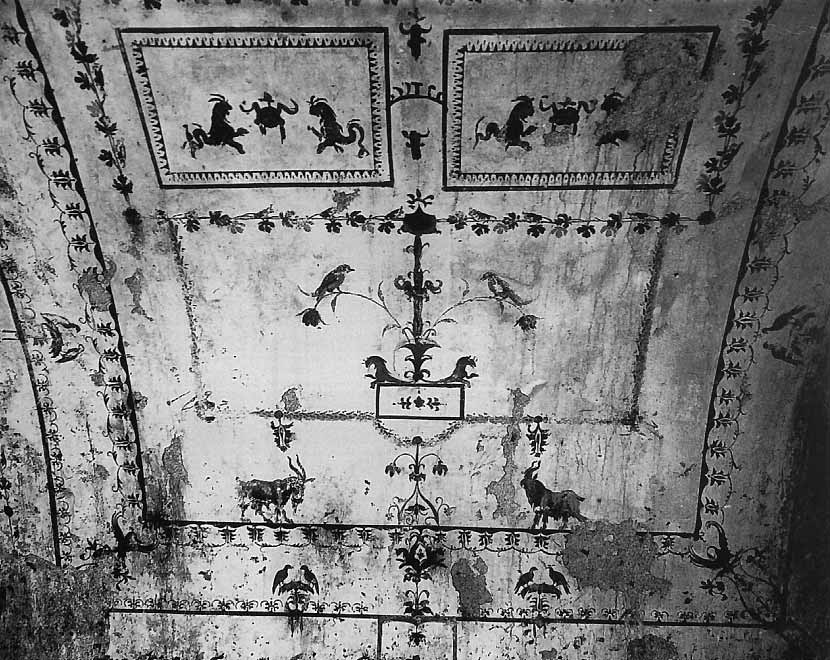
The Domus Aurea (Latin, "Golden House") was a large landscaped portico villa built by the Emperor Nero in the heart of ancient Rome, after the great fire in 64 C.E. had cleared away the aristocratic dwellings on the slopes of the Palatine Hill. The pleasure villa had hundreds of rooms, gardens and artificial lakes. His architectural complex was built on some 300 acres (1.2 km2).

Built of brick and concrete in the few years between the fire and Nero's suicide in 68, the extensive gold leaf that gave the villa its name was not the only extravagant element of its decor: stuccoed ceilings were faced with semi-precious stones and ivory veneers, while the walls were frescoed, coordinating the decoration into different themes in each major group of rooms.

The Golden House was designed as a place of entertainment, as shown by the presence of 300 rooms without any sleeping quarter. Nero's own palace remained on the Quirinal Hill. Strangely, no kitchens or latrines have been discovered yet either.

Frescoes covered every surface that was not more richly finished. The main artist was Fabullus. Fresco technique, working on damp plaster, demands a speedy and sure touch: Fabullus and assistants from his studio covered a spectacular amount of wall area with frescoes. Pliny the Elder, in his Natural History (77 CE.), recounts how Fabullus went for only a few hours each day to the Golden House, to work while the light was right. The swiftness of Fabullus's execution gives a wonderful unity and astonishing delicacy to his compositions.

Roman wall painting. Fabullus, Decorations in fantasy style, 1st century CE. Fresco detail. Domus Aurea, Rome

View of the cryptoporticus with illusionistic candelabra and figures from the Domus Aurea (Golden House of Nero), Rome (German Archaeological Institute, Rome).

Fabullus, Decorations in the 4th Pompeyan Style, 1st century CE. Domus Aura, Rome


Fresco details from the Domus Aurea of Nero, Rome

The Domus Aurea (Golden House), located between the Esquiline and Palatine Hills, was one of Nero's most extravagant projects. As everybody knows, two-thirds of the city of Rome were destroyed by a great fire in 64 AD. Nero used most of this land as a site for his new complex, which was not so much a palace as a series of buildings scattered over a landscaped "countryside", including an artificial lake. The main building was extravagantly crafted, and boasted rooms and hallways decorated almost entirely in gold. In the case of the Domus, we know the names of the architects in charge of the project, Severus and Celer, and that of Fabullus, the painter who decorated many rooms.

One of the most visible features of the Domus Aurea was the Colossus Neronis: a 36 meter (120 ft) high bronze statue of Nero placed just outside the entrance. This monstrosity was built in imitation of the Colossus of Rhodes, one of the Seven Wonders of the Ancient World.

The area of the property was 985 feet long by 295 feet in width or depth. Among the other things there was an amphitheatre, a market, and bath-gymnasium complex, served by an aqueduct 75 Km (50 miles) long. Baths were served by a flow of both salted water and sulphurous one from the Albulae springs near Tivoli. Upon the Caelian Hill there were beautiful gardens, zoos, woods and parks where all kinds of animals roamed. There were hundreds of statues, grottoes, fountains, nymphaeums, porticoes painted with romantic landscapes; multiple waterfalls flowed all over. The lake - where the Colosseum was later built - was surrounded by woods and fake sea villages, and it was so big that ships could manoeuvre in it. The rooms of the palace were decorated with rare stones and mother of pearl; in the banquet rooms the guests were inundated by flowers and perfumes from the ivory ceilings. One of the most famous of these rooms featured a circular roof painted with the stars and the planets, that revolved mechanically imitating the movement of the stars.

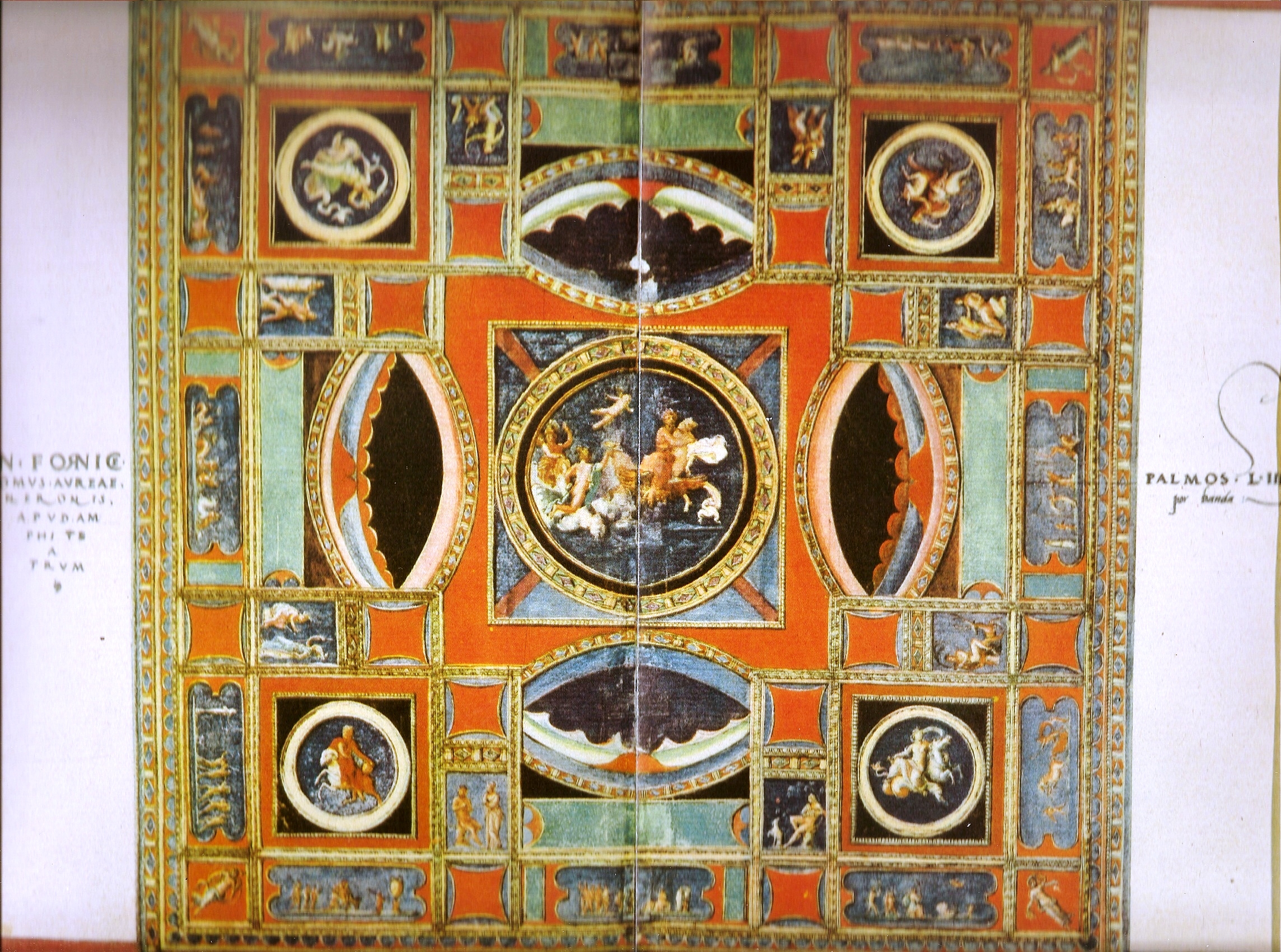
After the death of Nero, Vespasian reopened the property to the public, and the palaces of Nero were destroyed or recycled. The building we call Domus Aurea was covered by earth and on top of it were built around 80 AD great public baths called the Baths of Titus. Later on, from 104 to 109, Emperor Trajan built another massive complex of baths, dwarfing Titus' complex, the ruins of which can still be seen in the park of Colle Oppio. Enormous foundations were placed in the palace of Nero to support the new buildings, and this also helped to preserve what remained of the Domus. The ruins of the Domus were rediscovered by the artists in the XV century, and its paintings became a source of inspiration for many of them (e.g. Raphael in his decoration of the Logge Vaticane). Many of them left their graffiti on the walls. The Domus Aurea was then called "le grotte", and this seems to be the origin of the term "grottesco" (grotesque) for that particular style of painting (The Colosseum).


Virtual reality reconstruction


Influence in terms of iconography

Roman mosaic. Border with half-figure and grotesque head from the Baths of Trajan, Acholla, early 2nd century CE. Bardo Museum, Tunis (Photo by P. Perkins). Discussion


Roman mosaic from Carthage, Tunisia. Bardo Museum, Tunis


It can be seen most obviously in Raphael's decoration for the loggias in the Vatican, and the white walls, delicate swags, and bands of frieze, framed reserves containing figures and landscapes, which have returned at intervals ever since, notably in late 18th century Neoclassicism, making Fabullus one of the most influential painters in the history of art.

After Nero's suicide, the complex was stripped of valuables, filled in with earth, and buried for over 1500 years, until it was accidentally discovered by a boy who fell into a hole in the earth.

as the remains of the Domus Aurea were discovered under the Esquiline hill in Rome, artists including Raphael lowered themselves down on ropes into its subterranean painted galleries. The Renaissance frescoes this opulent palace inspired – all fantastical foliage, masks and satyrs – was called “grotesque” from grotto (cave) because the underground corridors were like caverns.

The strange ornamental designs that were found there featured elaborate fantasies with symmetrical anatomical impossibilities, small beasts, stylised human heads, and delicately-traced, indeterminate foliage all merged into one unified decorative whole.

Sixteen rooms of the Domus Aurea were discovered during the first systematic excavations carried out by Pope Clement XIII. Parts of the Domus —known then as Nero's grotte— were known prior to Clement's initiative.

The effect of the Domus Aurea frescoes on Renaissance artists was instant and profound. Its imagery was copied incessantly by Pinturicchio, Ghirlandaio, and Raphael.

In the late seventeenth century, Pietro Sante Bartoli uncovered other rooms of the Neronian complex and published a series of drawings based on these decorative motifs. The full luxury of Nero's Domus was unveiled between 1758 and 1769. An album of sixty etchings was published by the antiquarian Mirri in 1774, together with drawings and watercolor engravings by other artists.


Italian Renaissance Grotteschi, sometimes also referred to as La grottesca. Grotteschi (Grotesques, digital montage of images) by Mariano Akerman is licensed under a Creative Commons Attribution-NonCommercial-NoDerivs 3.0 Unported License. Based on a work at 3.bp.blogspot.com. For educational use only.
Creative Commons License

Online Resources. On Nero's building complex known as the Domus Aurea (Golden House), see Alargos, Tendências do imaginário and Antika. See also the Domus Aurea Image Gallery. On the importance of the Domus Aurea imagery during the Renaissance, see Alberti's Window. Francisco de Holanda made watercolors of a Domus Aurea room known as the Sala dalla Volta Dorata in 1538. His work is consonant with the remaining fragments of the original chamber, which were photographed in 2012, as L.A. Miller y M. Durand have aptly demonstrated. Both researchers have also put in evidence the presence of various irregularities and imprecisions in the engravings showing the same chamber and which were made by Vincenzo Brenna, Franciszek Smuglewicz and Marco Gregorio Carloni much later (Vestigia delle Terme di Tito e loro interne pitture, Roma, 1776; Orientalist, Domus Aurea 1776 and The Mystery of Plate 42). Additional images of Vestigia can be found in the Giornale Nuovo.


Fantasy style in ancient Roman painting
Sogni dei pittori
Raphael: The Vatican Loggia
Related Posts Plugin for WordPress, Blogger...